Top US Quantum Computing Providers in 2025: Comparison & Insights
Introduction
Quantum computing has leapt from theoretical curiosity and lab-scale experiments into real-world cloud platforms, enterprise pilots, and burgeoning commercial roadmaps. As of 2025, several U.S.-based companies and platforms stand out — offering different qubit technologies, varied levels of maturity, and distinct value propositions for enterprises, researchers, and investors.
This article serves as your 2025 guide to the leading U.S. providers of quantum computing systems. You’ll find: the latest (publicly available) specs, technology comparisons, enterprise-ready offerings, benchmark highlights, and practical recommendations — all framed for tech buyers, innovation leaders, and forward-looking investors.
Because quantum technologies evolve rapidly, many numbers cited here are labeled “as of 2025” — giving you a baseline snapshot, while acknowledging the fluid nature of the industry.
How to Evaluate Quantum Computing Providers (Without the Academic Overhead)
Before comparing vendors, it’s useful to understand which metrics and dimensions matter most when assessing quantum providers — especially from an enterprise or investment perspective.
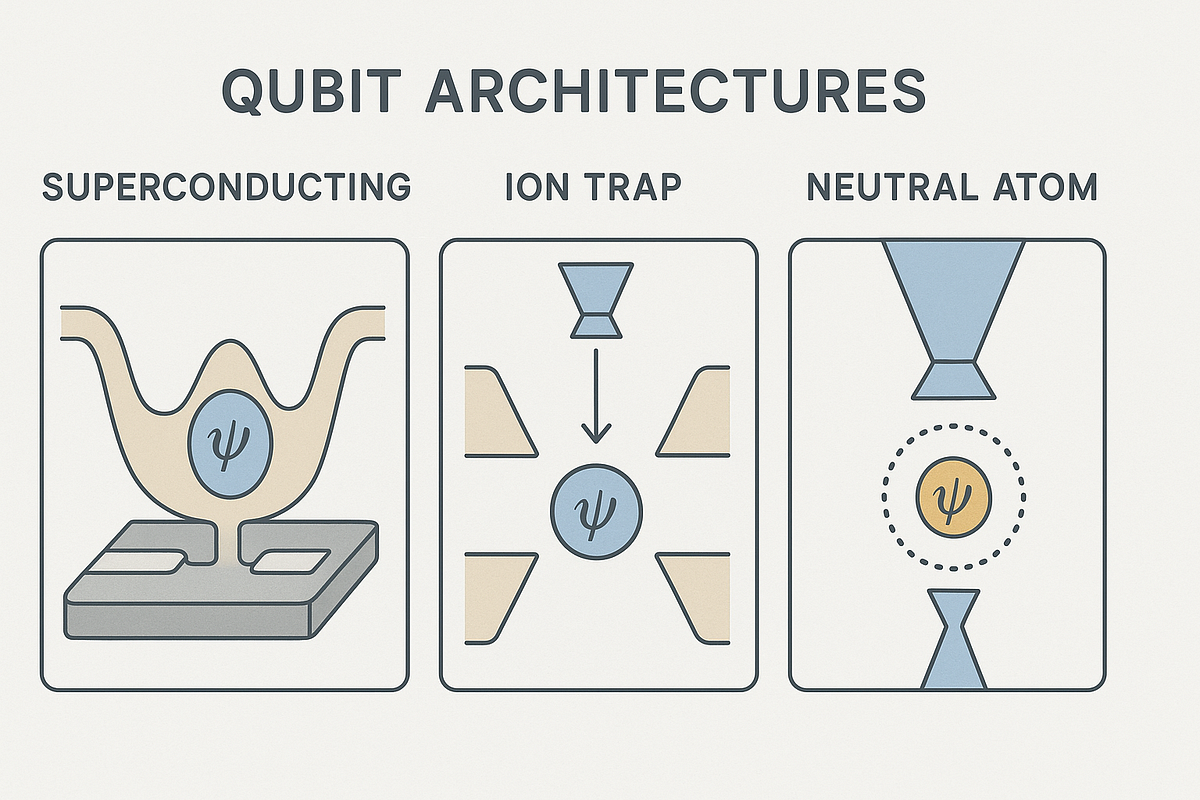
Qubit Technology & Architecture
- Superconducting Qubits — used by major players like IBM Quantum, Google Quantum AI, and Rigetti Computing. These rely on Josephson junctions and cryogenic circuits. McKinsey & Company+2asapdrew.com+2
- Trapped-Ion Qubits — championed by IonQ and Quantinuum- offer long coherence and high fidelity, though they tend to have slower gate speeds. investors.rigetti.com+2asapdrew.com+2
- Neutral-Atom / Other Emerging Modalities — companies like QuEra Computing (neutral-atom) — and other future-focused players — aim for large-scale, highly scalable quantum hardware. TechStock²+1
- Future/Experimental — photonic or hybrid architectures (less common today) but often cited for long-term potential. asapdrew.com+1
Key Performance Metrics
- Qubit Count: number of physical (and if available, logical or “algorithmic”) qubits — a raw measure of scale.
- Coherence & Fidelity / Error Rates: how stable qubits are, and how reliable gate operations or readouts are — crucial for algorithm correctness and depth.
- Quantum Volume / Benchmark Scores / “Algorithmic Qubits”: composite or derived metrics to reflect overall usable power.
- Cloud Access / Availability: whether systems are accessible through cloud or pay-per-use models. Real-world applicability often depends on this, not just on hardware existence.
- Scalability / Roadmap: provider plans for next-generation machines, and whether their strategy appears realistic.
- Ecosystem & Support: SDKs, developer tools, hybrid classical–quantum workflows, enterprise support, and managed services.
- Enterprise Readiness & Use-Case Alignment: whether the provider has real use-case pilots, partnerships, or documented industry applications (e.g., chemistry simulation, optimization, ML).
- Cost & Access Model: on-prem vs cloud, pay-per-use, subscriptions, enterprise licensing — important for budget planning.

These criteria will shape the “leaderboard” evaluation below.
Leaderboard Overview: Top US Quantum Computing Providers (2025)
Below is a summary of the leading U.S.-based quantum computing providers (hardware and cloud), with their core attributes, architecture types, and strategic positioning. Think of this as your at-a-glance cheat sheet.
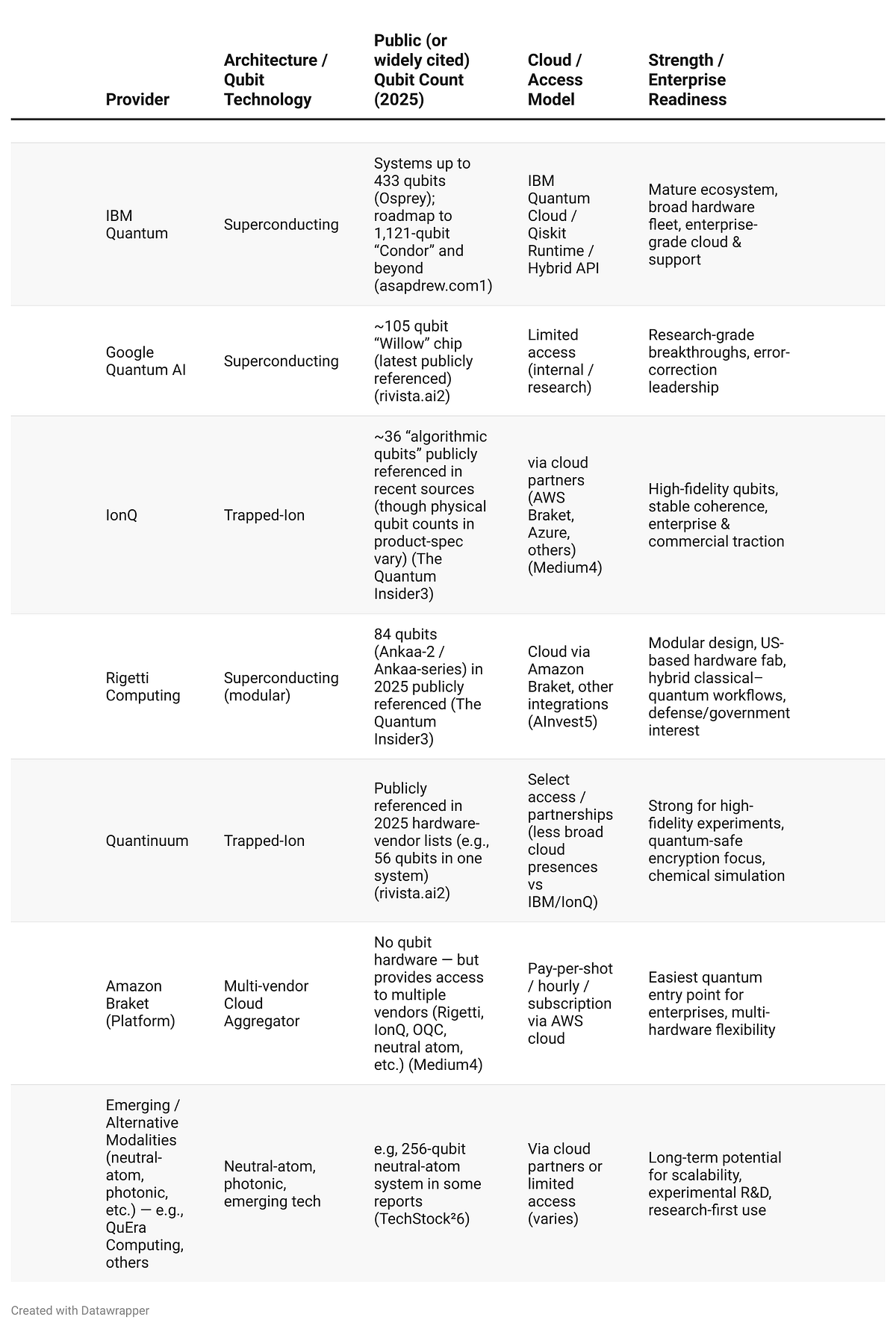
⚠️ Note: Qubit counts and “public system” numbers represent publicly disclosed or widely reported devices as of 2025. Because different vendors report differently (physical vs “algorithmic” vs “logical” qubits), interpret count as an approximate scale indicator — not a precise “performance guarantee.”
Deep-Dive Profiles — What Each Major Provider Brings (and Where They Stand in 2025)
IBM Quantum — The Enterprise-Ready Heavyweight
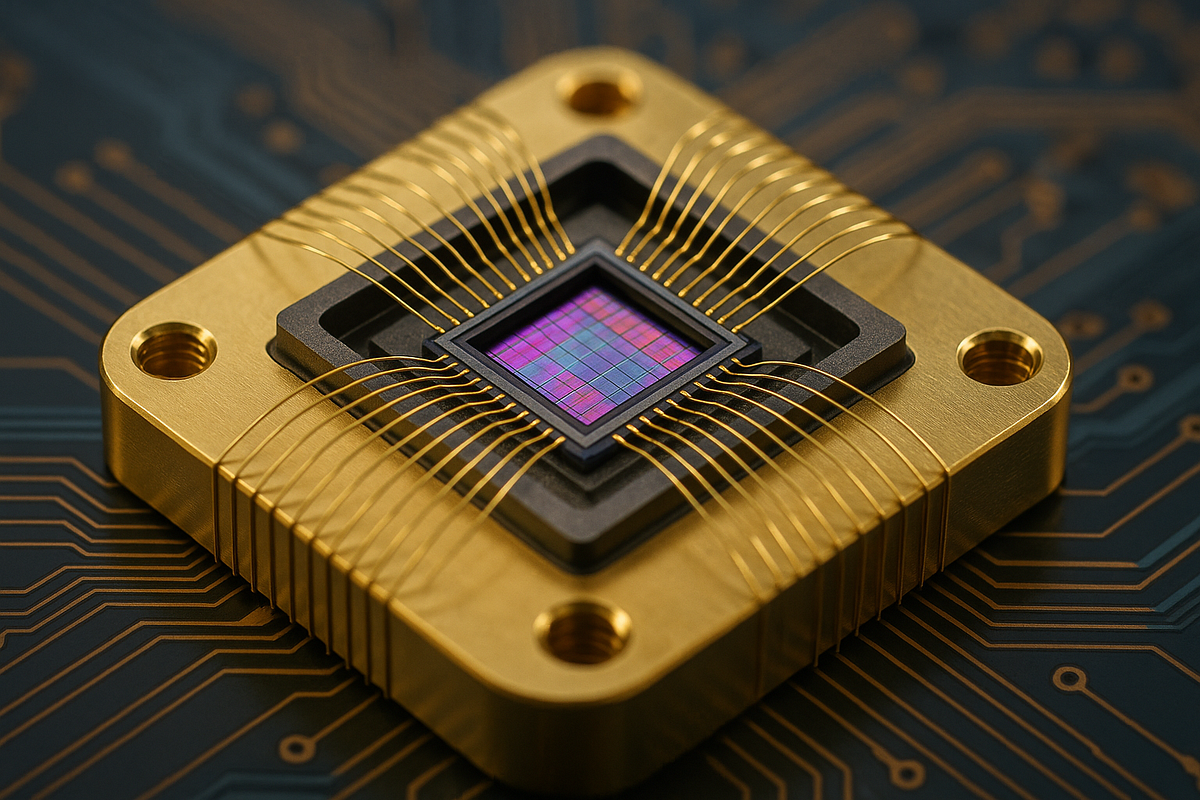
- Technology: Superconducting. Offers multiple hardware generations — from mid-range to high-qubit-count systems. EM360Tech+2asapdrew.com+2
- 2025 Snapshot: Public systems include 433-qubit (Osprey) machines. Roadmap includes a 1,121-qubit “Condor” system. asapdrew.com+1
- Access & Ecosystem: IBM Quantum Cloud, supported by Qiskit Runtime and hybrid execution APIs. This makes it relatively easy for enterprises to start testing quantum algorithms today, without huge capital expenditure. Medium+1
- Why It Matters: IBM offers arguably the broadest fleet of deployable quantum hardware today — making it the most mature, production-ready superconducting option. For enterprises wanting to run pilot projects (optimizations, simulations, hybrid workloads), IBM’s ecosystem + support is hard to beat.
- Trade-offs: As with all superconducting approaches, error rates and coherence remain challenges for deep circuits; scaling logical qubits requires error correction overhead.
Best For: Enterprises exploring quantum pilots — simulations, chemistry, optimization — with minimal upfront hardware investment.
Google Quantum AI — The Research-First Innovator
- Technology: Superconducting, with advanced surface-code error-correction ambitions. asapdrew.com+1
- 2025 Snapshot: Publicly referenced ~105-qubit “Willow” chip in some sources. rivista.ai+1
- Access & Positioning: Google’s quantum hardware remains largely research-oriented, with limited general public or enterprise cloud access (compared to IBM or AWS-based platforms).
- Why It Matters: Google continues to push the frontier in error correction, logical qubit architecture, and deep-research quantum algorithms — making them key if you care about long-term breakthroughs, fault tolerance, or advanced algorithm research.
- Trade-offs: Not the most enterprise-ready for commercial workloads; likely better suited for labs, R&D-focused organizations, or advanced academic collaborators.

Best For: Research institutions, advanced labs, or companies with long-term strategic quantum R&D agendas.
IonQ — Trapped-Ion Simplicity & Commercial Accessibility
- Technology: Trapped-ion qubits — known for high coherence and fidelity, though slower gate operations compared to superconducting qubits. investors.rigetti.com+1
- 2025 Snapshot: Publicly referenced ~36 “algorithmic” qubits (though physical qubit counts and exact specs vary by system). The Quantum Insider+1
- Access & Ecosystem: Available via major cloud partners like AWS Braket and other platforms — facilitating enterprise access without hardware ownership burdens. Medium+1
- Why It Matters: IonQ offers a stable, high-fidelity trapped-ion platform that can appeal to enterprises focusing on tasks where precision and reliability matter (e.g., chemistry simulation, optimization, ML workflows).
- Trade-offs: Slower gate speeds and possibly lower throughput compared to superconducting platforms — may limit performance for algorithms sensitive to depth or runtime.

Best For: Organizations prioritizing fidelity and stability over raw speed or qubit count — e.g., chemical simulation, small-to-mid-sized optimization tasks, quantum-inspired ML/AI experiments.
Rigetti Computing — Modular Superconducting with U.S.-based Manufacturing
- Technology: Superconducting, modular/fab-based architecture. investors.rigetti.com+1
- 2025 Snapshot: Publicly referenced 84-qubit system (Ankaa-2 or similar). The Quantum Insider+1
- Access & Ecosystem: Systems available via cloud (e.g., AWS Braket), with hybrid classical-quantum workflows, appealing especially to organizations comfortable embedding quantum as part of larger compute stacks. AInvest+1
- Why It Matters: Because Rigetti has its own U.S.-based fabrication pipeline (“Fab-1 quantum foundry”), it has more control over chip production and iteration — a potential advantage for scalability, custom integration, and long-term supply chain resilience. AInvest+1
- Trade-offs: The qubit count (as of 2025) is modest relative to IBM’s roadmap; the platform is less “polished” than IBM’s cloud offering; it may require more in-house technical maturity to use effectively.
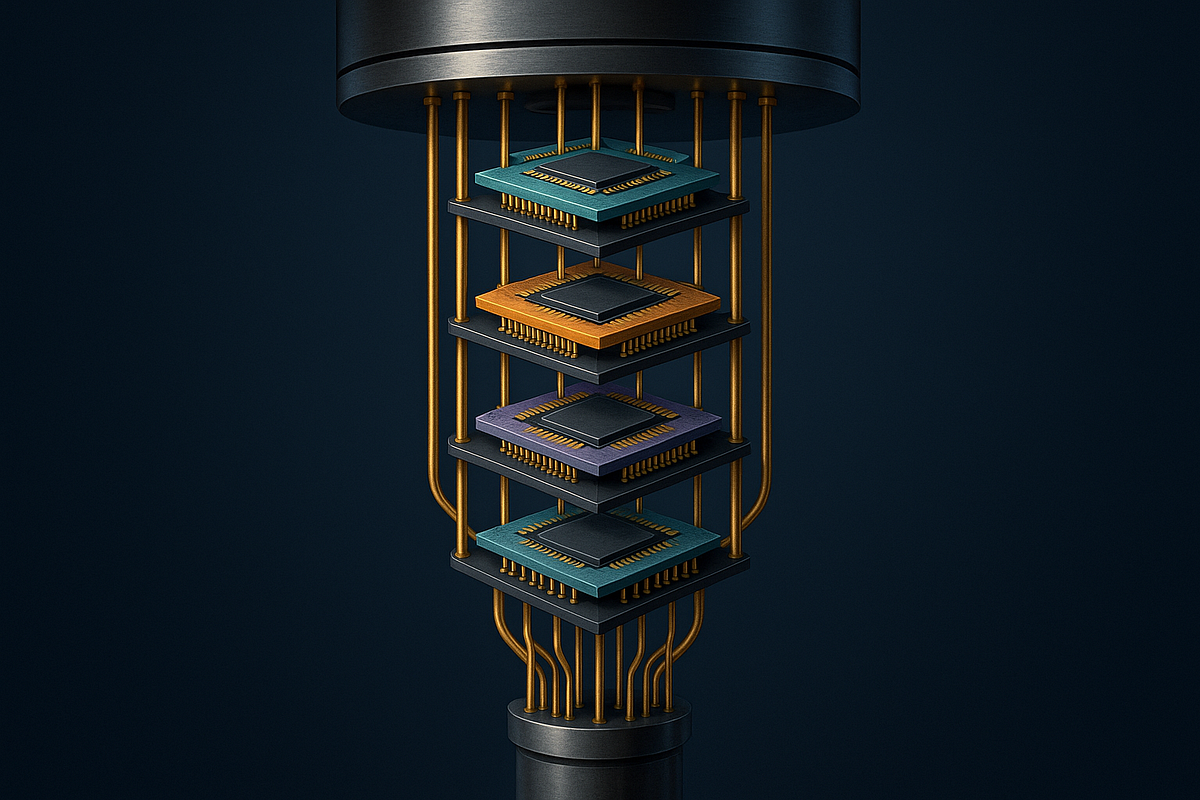
Best For: Government or defense-adjacent organizations, research labs, or enterprises looking for U.S.-based hardware and modular custom quantum infrastructure.
Quantinuum — Trapped-Ion Deep Performance & Specialized Use Cases
- Technology: Trapped-ion (QCCD-style) systems. rivista.ai+1
- 2025 Snapshot: Public vendor/hardware lists reference Quantinuum with quantum hardware in 2025. rivista.ai+1
- Access & Ecosystem: More limited in the general public cloud compared to IBM or AWS-based vendors — tends to focus on partnerships, research, and specialized enterprise or scientific applications.
- Why It Matters: For high-fidelity quantum simulations (chemistry, materials science), quantum-safe cryptography research, or advanced algorithm development, Quantinuum offers one of the most mature trapped-ion platforms in the U.S. marketplace.
- Trade-offs: Less accessible for “easy cloud startup” compared to some peers, and fewer “mass-market” enterprise use cases.

Best For: Pharma/chemistry R&D, companies prioritizing quantum-safe encryption or simulation fidelity, academic collaborations, or organizations planning long-term quantum investment.
Amazon Braket — The Cloud Gateway to Multiple Quantum Hardware Types
- Role: Not a hardware maker — but a multi-vendor quantum cloud aggregator. Provides access to quantum hardware from vendors like IonQ, Rigetti, neutral-atom, and others via AWS infrastructure. Medium+1
- Why It Matters: For enterprises and teams dipping their toes into quantum computing, Braket dramatically lowers the barrier to entry: no hardware procurement, straightforward billing, scalable usage, and support for hybrid workflows.
- Use Cases & Flexibility: Ideal for testing, prototyping, and pilot projects — whether you want to explore optimization, ML, simulation, or quantum-inspired algorithms — across different hardware backends without locking into a single vendor.
- Trade-offs: Because Braket pools diverse hardware, performance can vary widely depending on the backend. For mission-critical workloads, enterprises may still prefer dedicated hardware or vendor-specific platforms.
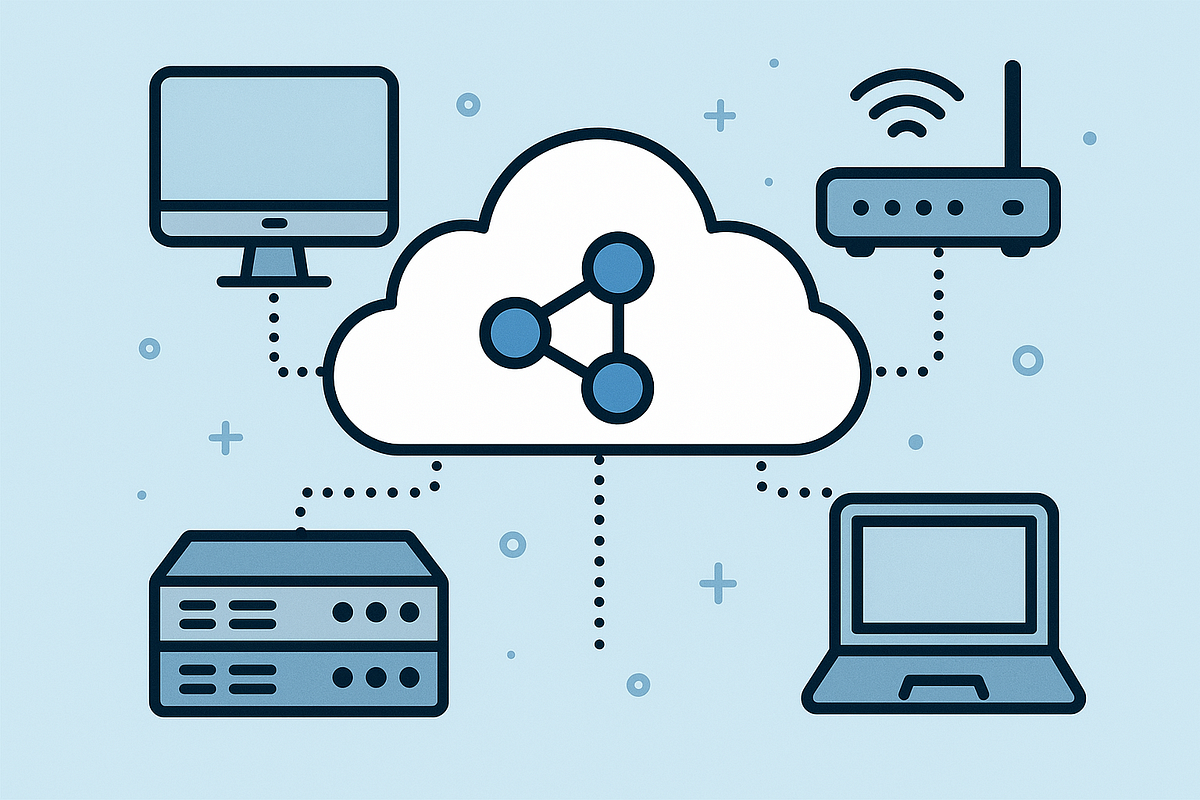
Best For: Enterprises curious about quantum but not ready to commit heavy capital — especially those wanting to evaluate different hardware modalities and workflows quickly and flexibly.
Use-Case Recommendations: What Quantum Use Cases Make Sense for Enterprises in 2025
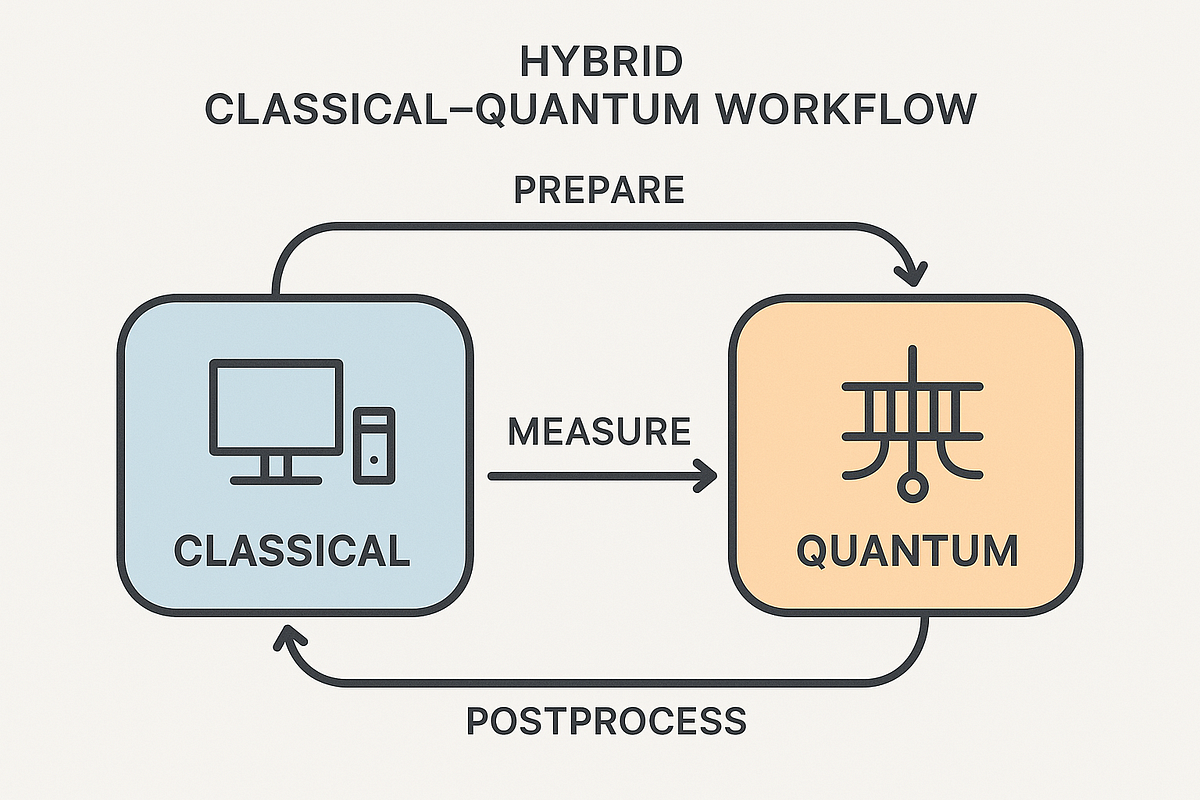
Quantum computing hasn’t yet “solved everything,” but several use-cases are emerging as viable (or close to viable) in 2025 — especially when approached via hybrid classical-quantum workflows or cloud-based platforms.
1. Optimization & Logistics
Use-case: Supply chain routing, scheduling, resource allocation, vehicle routing, logistics optimization.
- Who’s good at it: Rigetti (modular superconducting), IonQ (stability/fidelity), IBM (cloud + hybrid APIs).
- Why it works now: These tasks often map well onto near-term quantum algorithms or quantum-inspired heuristics — offering potential speedups without requiring fault-tolerant hardware.

2. Materials & Chemistry Simulation
Use-case: Drug discovery, battery materials, molecular modeling, chemical reaction simulations.
- Who’s good at it: Quantinuum (ion-trap fidelity), IonQ (trapped-ion), IBM (cloud accessibility).
- Why it works now: High-fidelity qubits and hybrid quantum-classical workflows can help approximate quantum chemistry problems sooner than full-scale quantum advantage — ideal for pharma, materials science, and R&D-heavy sectors.

3. Machine Learning & AI Acceleration (Quantum + Classical Hybrid)
Use-case: Quantum-enhanced ML, optimization for ML model training, and hybrid quantum-classical pipelines.
- Who’s good at it: IBM (Qiskit + Runtime), Rigetti (modular + hybrid workflows), IonQ (stable ion-trap qubits).
- Why it works now: Enterprises can experiment with quantum-inspired ML models or quantum-assisted optimizations without needing large qubit counts or full fault tolerance.
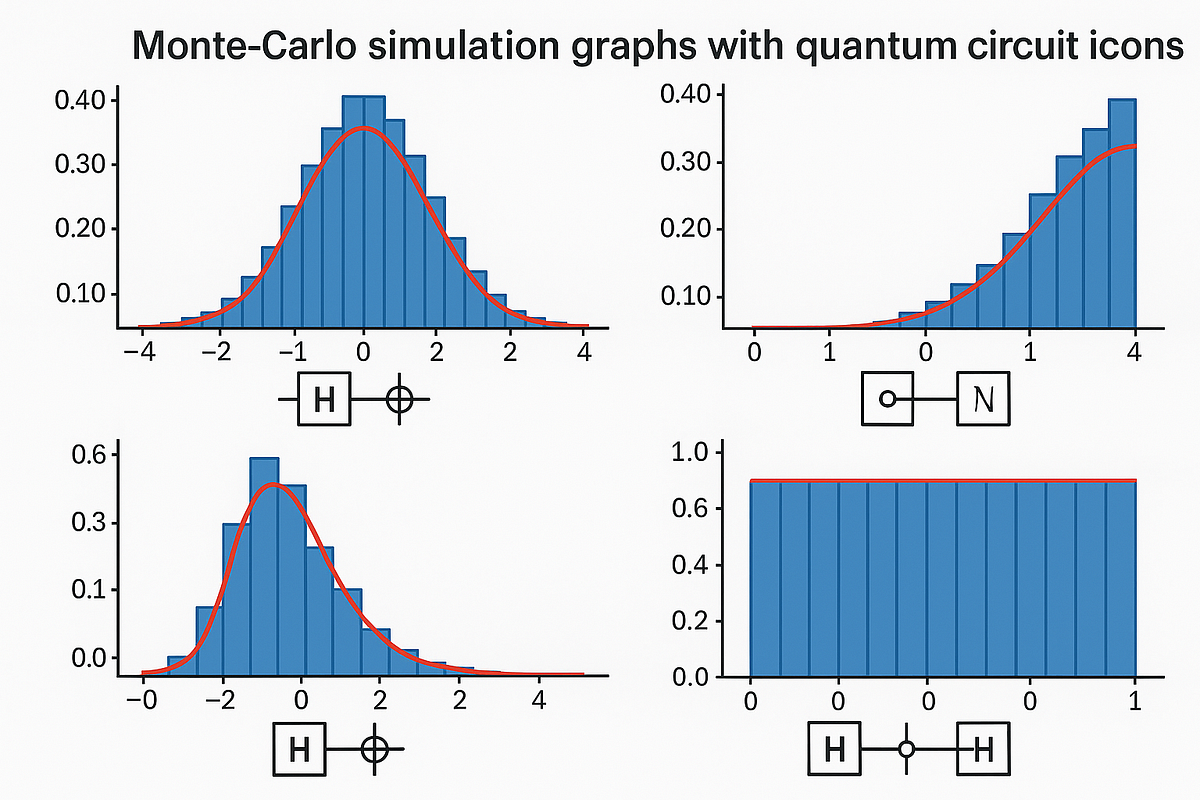
4. (Emerging) Finance, Monte Carlo & Risk Modeling
Use-case: Complex Monte Carlo simulations, portfolio risk modeling, derivative pricing, and large-scale simulations.
- Who’s good at it: Cloud platforms like AWS Braket, IBM — offering flexible access across hardware backends.
- Why it works soon: As quantum cloud access becomes more available (and companies build libraries for finance use-cases), enterprises and financial institutions may gain an early advantage in simulation-heavy tasks.
Cloud vs On-Prem: What Enterprises Should Do in 2025
Why Cloud Is the Best Entry Point Today
- Low Barrier to Entry: No need for cryogenic labs, specialized hardware facilities, or big capex.
- Flexibility & Variety: Access multiple hardware types (superconducting, trapped-ion, neutral-atom) via a single interface/platform.
- Scalability in OPEX Model: Pay-per-use or subscription — fits modern enterprise budgeting (opex over capex).
- Hybrid Workflows & Ecosystem Support: SDKs, integration with classical compute, and managed services.
When On-Prem or Dedicated Hardware Still Makes Sense
- Organizations handling sensitive data or IP require maximum control and security.
- R&D labs or firms with deep quantum roadmaps, wanting to avoid vendor lock-in and customize hardware/firmware.
- Use-cases demanding consistent, high-performance execution over time (e.g., high-fidelity simulations, quantum algorithm development, error correction research).
Recommended Enterprise Entry Path (2025)
- Start with a cloud sandbox — via AWS Braket, IBM Quantum Cloud, or similar.
- Run pilot projects: optimization, simulation, proof-of-concept.
- Evaluate which hardware modality and provider fits best (fidelity, cost, performance).
- For promising use-cases or long-term strategy, consider dedicated hardware or a hybrid on-prem + cloud deployment.
Risks, Challenges & Market Realities (What Every Buyer / Investor Should Watch)
Enterprises and investors need a balanced view. Here are key risks and limitations for quantum adoption in 2025:
Technical & Development Risks
- Error rates & noise: Despite progress, superconducting and trapped-ion systems still suffer from noise, error rates, and limited coherence times. Real-world usefulness often demands error mitigation, which adds complexity.
- Scalability remains uncertain: Publicly disclosed systems reach dozens to a few hundred qubits; scaling to thousands or logical qubits is still a multi-year challenge.
- Lack of fault tolerance / fully error-corrected systems: Today’s machines are largely “noisy” — most algorithms remain limited to small-depth circuits or approximate results.

Enterprise & Business Risks
- Talent shortage: Skilled quantum engineers, developers, and scientists remain rare. Building effective quantum workflows requires domain expertise.
- Cost & unpredictability: Even cloud access is not trivial cost-wise (especially for serious experiments). ROI is uncertain.
- Vendor lock-in & ecosystem fragmentation: Choosing one vendor or cloud platform may limit flexibility, especially as hardware modalities diverge (superconducting vs ion-trap vs neutral atom).
- Regulatory, compliance & security concerns: As quantum computing impacts cryptography and sensitive data handling, enterprises may face new regulatory scrutiny or requirements — especially in telecom, finance, healthcare, or government sectors.
Geopolitical & Supply-Chain Risks
- Global competition: Other regions (EU, Asia) are aggressively investing in quantum — competition could influence supply, standards, and collaborations.
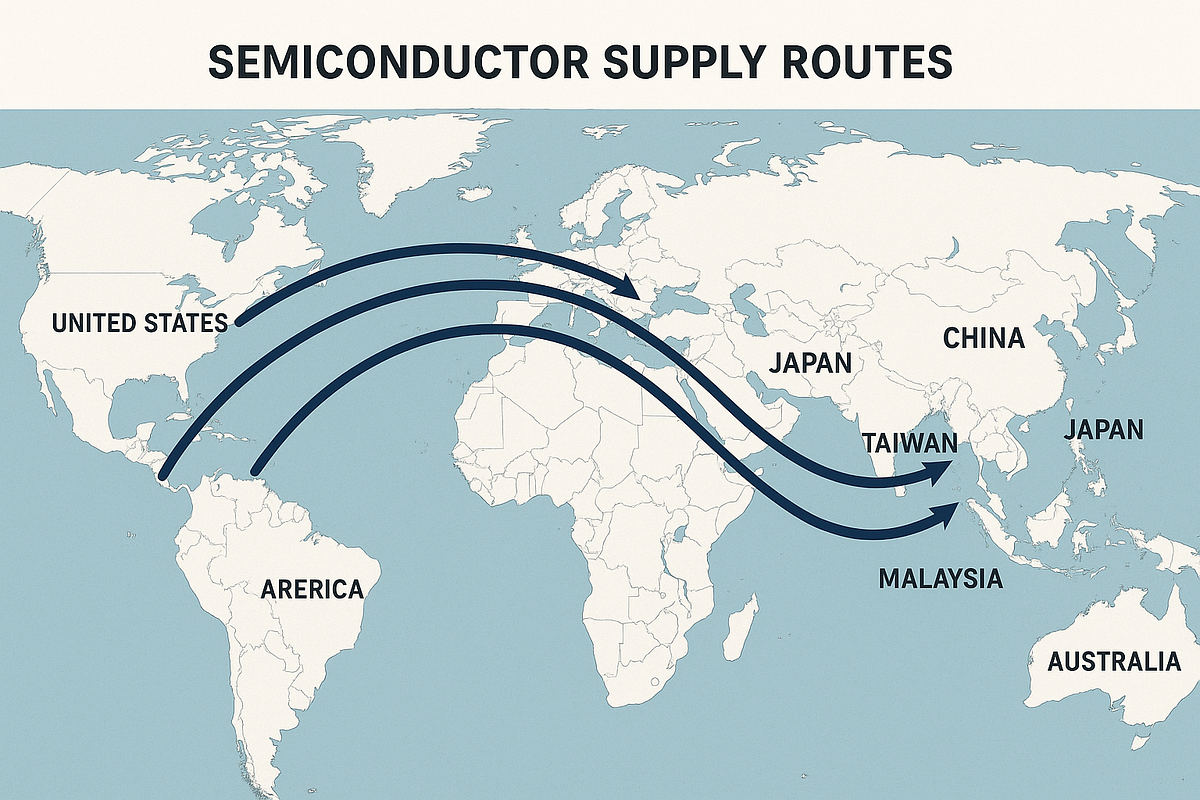
- Hardware supply constraints: Specialized fabrication, cryogenics, and rare materials may cause delays, especially if demand surges.
- Quantum-safe security arms race: As quantum computing advances, organizations must plan now for eventual quantum-resistant cryptography, which introduces compliance and transition risks.
Outlook: What to Expect Between 2026–2030
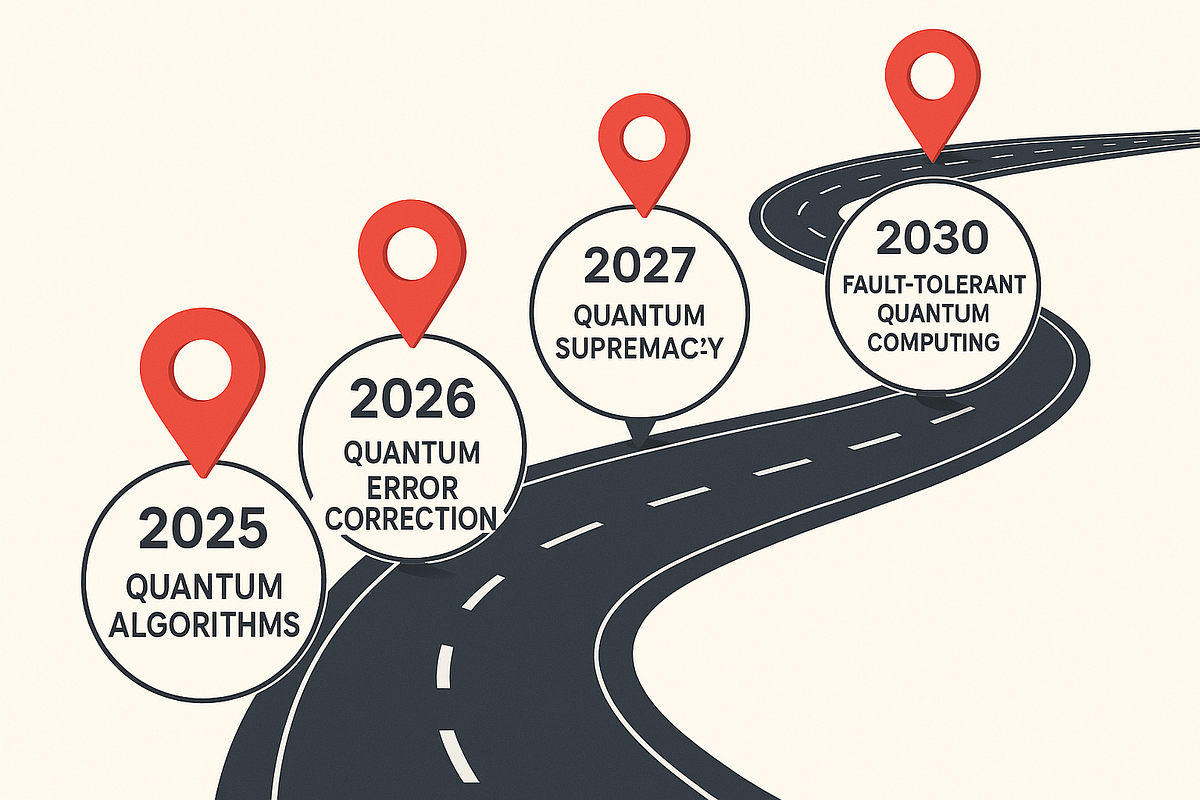
Looking ahead, the quantum computing field is likely to evolve along several axes:
- Logical / error-corrected qubits start to emerge — several vendors are working toward demonstrable logical-qubit systems, which could enable deeper algorithms and more practical quantum advantage.
- Diverse architectures mature — beyond superconducting and trapped-ion: neutral-atom, photonic, hybrid systems, possibly delivering large-scale, high-qubit-count machines.
- Broader cloud adoption & enterprise integration — as cloud platforms expand support, we may see quantum computing integrated into enterprise software stacks as a service, not standalone hardware.
- Convergence of quantum and classical computing + AI — hybrid quantum-classical workflows, quantum-enhanced ML/AI, and quantum-accelerated simulation may become standard in sectors like materials science, pharma, logistics, and finance.
- Growth in quantum-safe security and cryptography demand — as quantum hardware matures, demand for quantum-resistant encryption will increase, pushing enterprises to plan.

Conclusion: Who’s “Best”? It Depends — But Here’s My Take (2025 Benchmark)
There is no single “winner.” Instead, each provider fits a different enterprise or research need.
- Best for enterprise-ready cloud experimentation and broad access: IBM Quantum — mature infrastructure, scalable hardware fleet, strong developer ecosystem.
- Best for cutting-edge research and long-term error-correction ambitions: Google Quantum AI — deep research strength, error-correction roadmap, strong scientific legacy.
- Best for stable, high-fidelity quantum hardware accessible via cloud: IonQ — trapped-ion reliability, good for simulation, hybrid workflows, and early commercial use-cases.
- Best for modular, U.S.-based superconducting hardware with potential customization: Rigetti Computing — attractive for government, defense, or custom quantum infrastructure.
- Best for deep-research or high-fidelity simulation applications (chemistry, encryption, quantum-safe): Quantinuum — trapped-ion excellence, specialized focus.
- Best for easiest enterprise entry / vendor-agnostic experimentation: Amazon Braket (multi-vendor access) — flexible selection of hardware, minimal overhead, cost-effective experimentation.
- Promising for long-term scalability and alternative architectures: Emerging neutral-atom or photonic players (e.g., QuEra, others) — worth watching if you’re thinking long-term horizon.
My recommendation for enterprises today (2025):
Start with cloud access — using a platform like Amazon Braket or IBM Quantum Cloud — to experiment, build familiarity, and run pilot workloads. Use those insights to decide whether you need to commit to a specific provider or hardware type. For R&D-heavy or simulation-intensive projects (chemistry, materials, ML), consider working with trapped-ion or emerging architectures, or even hybrid classical-quantum solutions.
For investors, the landscape remains fragmented — but companies with clear roadmaps, strong ecosystems, and multi-modal flexibility (cloud, hardware, software) are likely to lead in 2026–2030.


Comments
Post a Comment