Foundations of Quantum Computing Systems Explained
Quantum computing is often discussed in terms of qubits, superposition, and exotic algorithms. While these concepts are foundational, they only tell a fraction of the story. In practice, a quantum computer is not a single device but a deeply integrated system — one that spans fragile physical hardware, complex control electronics, sophisticated software stacks, and tightly coupled classical infrastructure.
Understanding quantum computing, therefore, requires systems thinking. Quantum computers are not faster versions of classical machines, nor are they poised to replace existing infrastructure in the near term. They are highly specialized accelerators, constrained by physics, enabled by engineering, and shaped by hardware–software co-design.
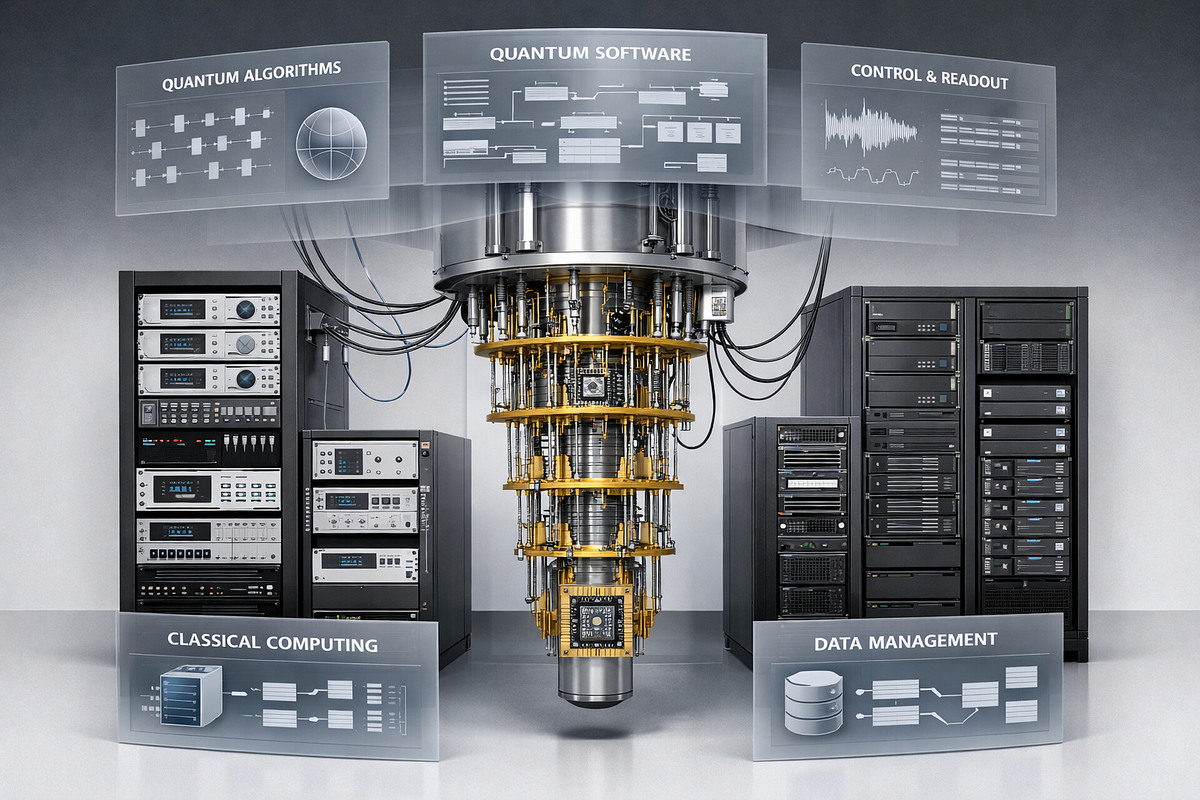
This article examines the foundations of quantum computing systems from an end-to-end perspective. Rather than focusing narrowly on theory or algorithms, it explores how real quantum systems are structured, where their bottlenecks emerge, and why system-level integration — not qubit count alone — will determine their long-term impact.
Quantum Computing Is Not a Faster Classical Computer
One of the most persistent misconceptions about quantum computing is that it represents a linear performance upgrade over classical systems. This framing leads to unrealistic expectations: more qubits are assumed to mean more speed, and quantum computers are expected to replace CPUs or GPUs outright.
In reality, quantum computers solve a narrow class of problems by exploiting quantum mechanical effects such as superposition and entanglement. These effects are extraordinarily fragile. Maintaining them requires extreme environmental control, precise timing, and continuous classical intervention.

Performance, therefore, is not dictated by qubit count alone. It emerges from a combination of factors, including:
- Qubit coherence times
- Gate and measurement fidelity
- Connectivity and topology
- Control electronics precision
- Error accumulation and mitigation
- Software compilation and orchestration
A quantum processor with many qubits but poor coherence or high error rates may be less useful than a smaller, better-controlled system. This is why system-level performance metrics matter far more than headline qubit numbers.
The Physical Foundations: What Qubits Can — and Cannot — Do
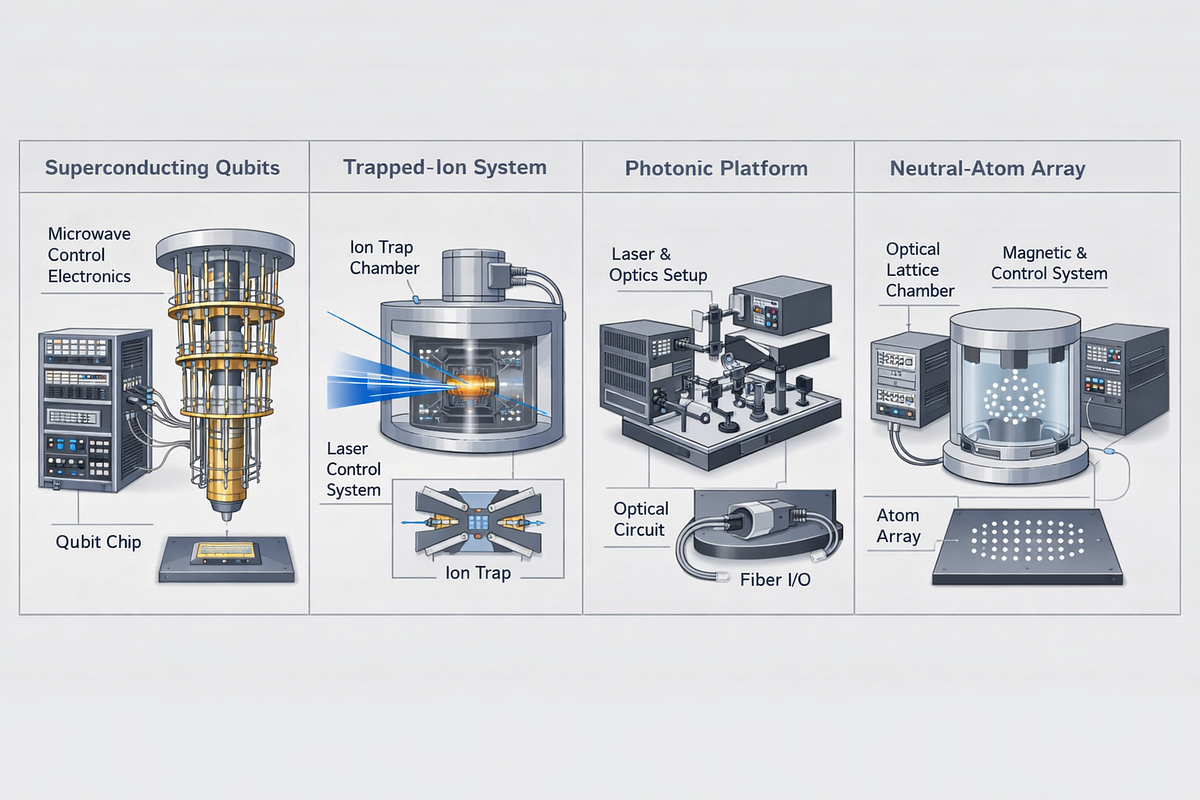
At the lowest level, quantum computing systems are built on physical qubits. These qubits may be implemented using superconducting circuits, trapped ions, neutral atoms, photons, or other modalities. Each approach encodes quantum information differently, but all share a common challenge: quantum states are inherently unstable.
Qubits are susceptible to:
- Decoherence, where interactions with the environment destroy quantum information
- Control errors, caused by imperfect pulses or timing
- Crosstalk, where operations on one qubit unintentionally affect others
These limitations constrain circuit depth — the number of operations that can be reliably executed before errors dominate. As a result, today’s quantum systems operate in what is often referred to as the noisy intermediate-scale quantum (NISQ) regime.
From a systems perspective, this means:
- Hardware quality directly constrains algorithm design
- Software must adapt to noise and limited connectivity
- Classical computation is required to manage and compensate for imperfections
The physical layer defines the ceiling for everything above it.
Beyond Qubits: Control Electronics and Cryogenic Infrastructure
Quantum processors do not operate in isolation. They depend on an extensive control infrastructure to function at all.
For many leading qubit technologies — particularly superconducting qubits — this includes:
- Cryogenic systems that maintain temperatures near absolute zero
- High-precision microwave or laser control electronics
- Timing and synchronization hardware
- Continuous monitoring and calibration systems
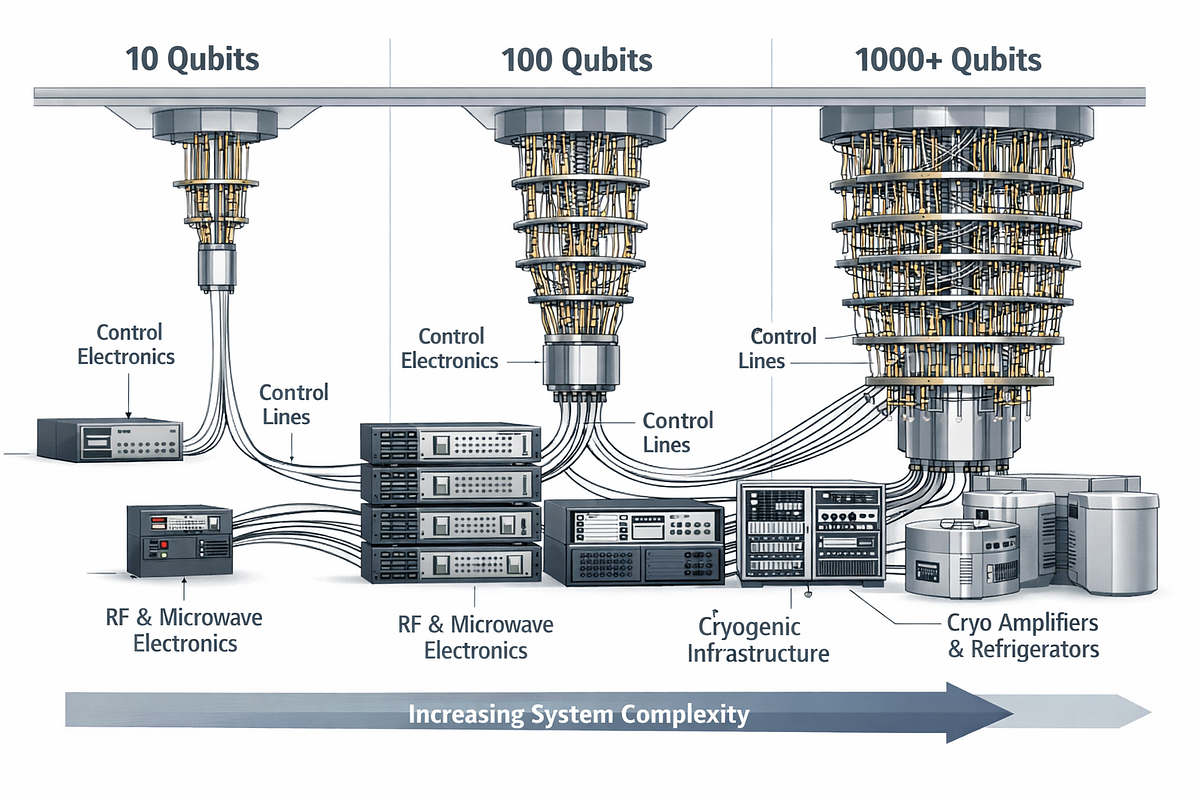
As quantum systems scale beyond tens or hundreds of qubits, these supporting layers often become the dominant engineering challenge. Routing thousands of control lines into cryogenic environments, managing heat loads, and maintaining signal integrity introduces complexity that grows faster than qubit count itself.
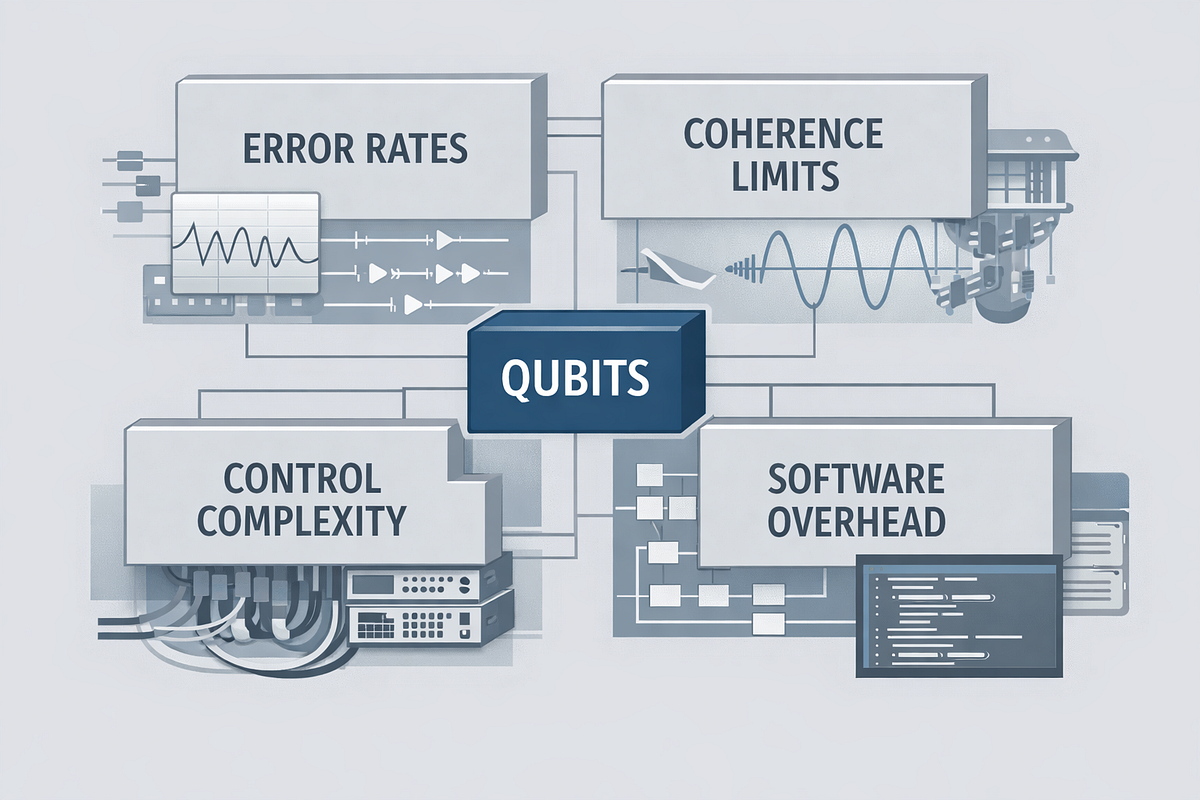
This is one of the least appreciated realities of quantum computing: scaling control infrastructure is often harder than scaling qubits.
From a systems standpoint, progress depends not only on better qubits, but on:
- Integrated and miniaturized control electronics
- Improved cryogenic engineering
- Architectural decisions that reduce control overhead
Ignoring these layers leads to designs that are impressive on paper but impractical in deployment.
Quantum Computing as a Hybrid Classical–Quantum System
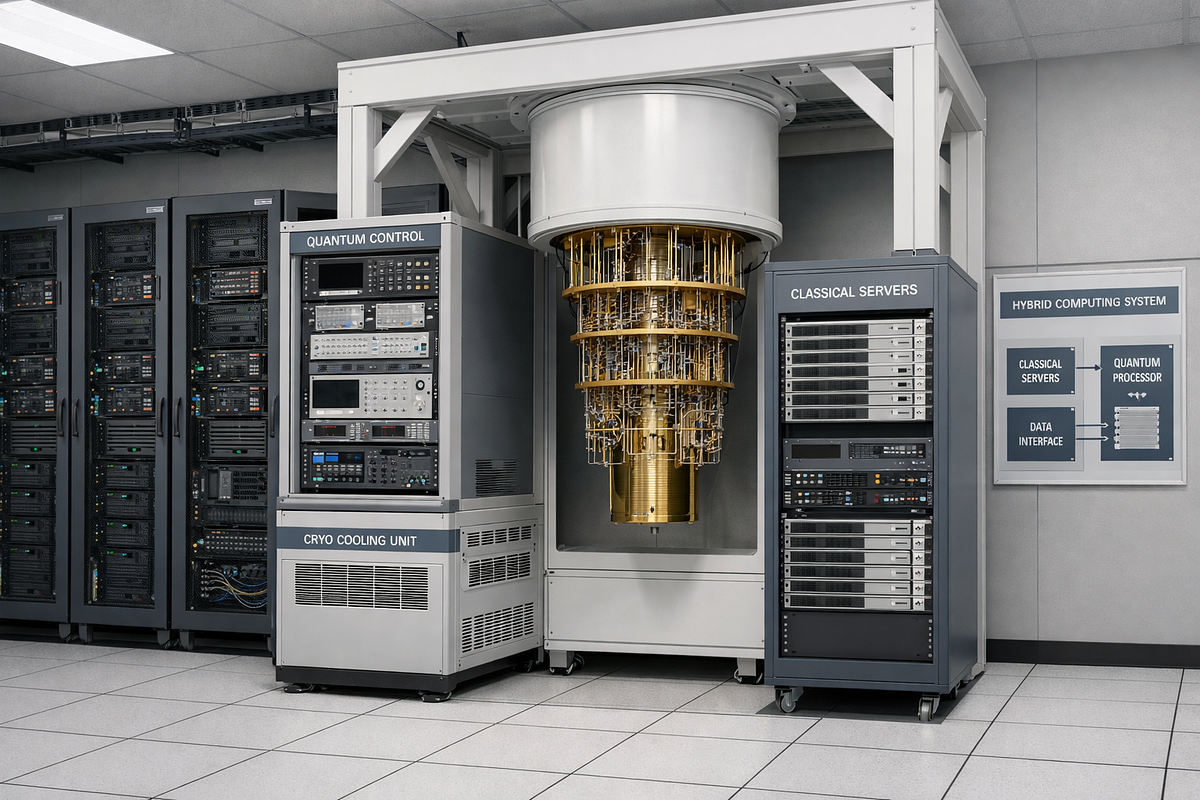
Despite their name, quantum computers are fundamentally hybrid systems. Classical computing remains dominant across nearly every operational layer, including:
- Pulse generation and control sequencing
- Calibration, monitoring, and feedback loops
- Error mitigation and decoding
- Compilation and optimization
- Hybrid algorithm execution
In practice, quantum processors behave much as specialized accelerators — analogous to GPUs or TPUs — invoked by classical hosts to perform specific subroutines.
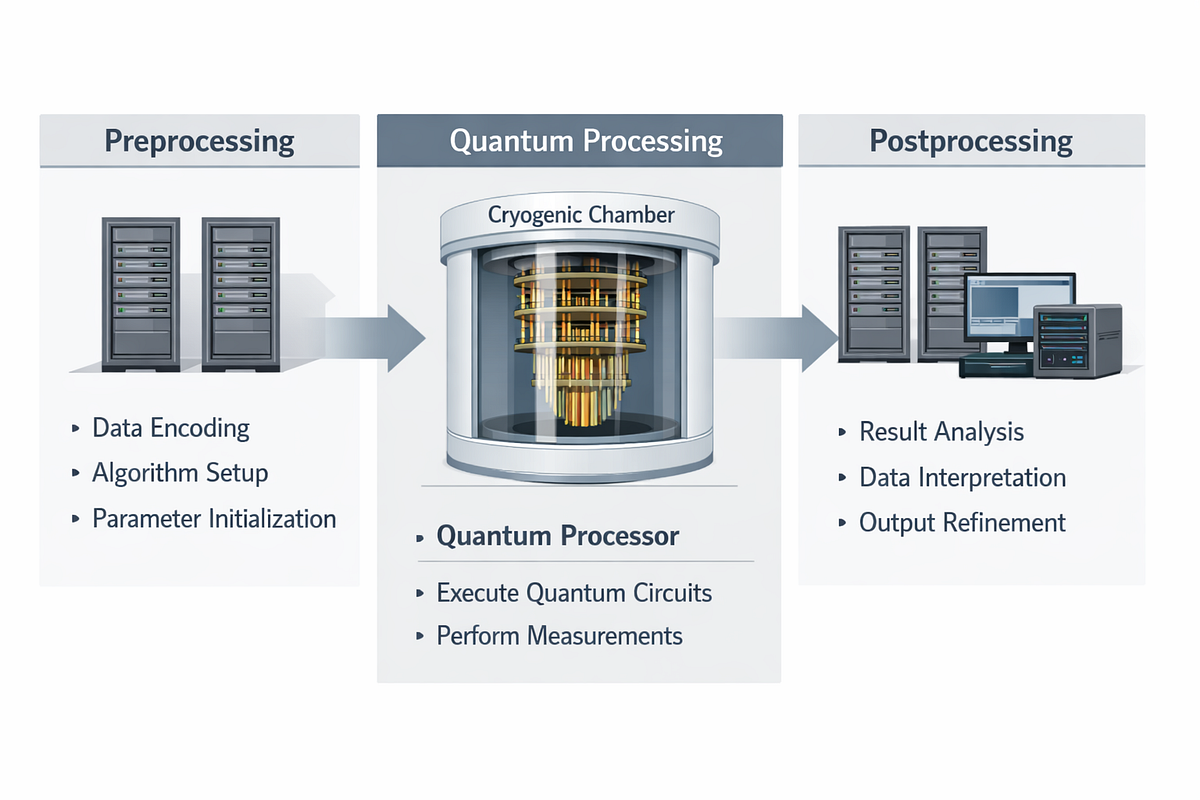
A typical workflow looks like this:
- A classical computer defines a high-level problem
- Quantum circuits are compiled and optimized for a target device
- The quantum processor executes short, noisy circuits
- Measurement results are returned to classical systems
- Classical post-processing interprets and refines results
This tight classical–quantum coupling is not a temporary crutch. It is a defining architectural feature of near- and medium-term quantum computing systems.
The Software Stack: Where Theory Meets Reality
Quantum software is often discussed in terms of algorithms, but in operational systems, the software stack is far broader. It includes:
- High-level programming frameworks
- Compilers that map abstract circuits to physical qubits
- Noise-aware optimizers
- Runtime systems for hybrid execution
- Error mitigation libraries
Each layer must adapt to hardware constraints such as connectivity, gate sets, and error characteristics. A theoretically elegant algorithm may perform poorly if it maps inefficiently onto a real device.
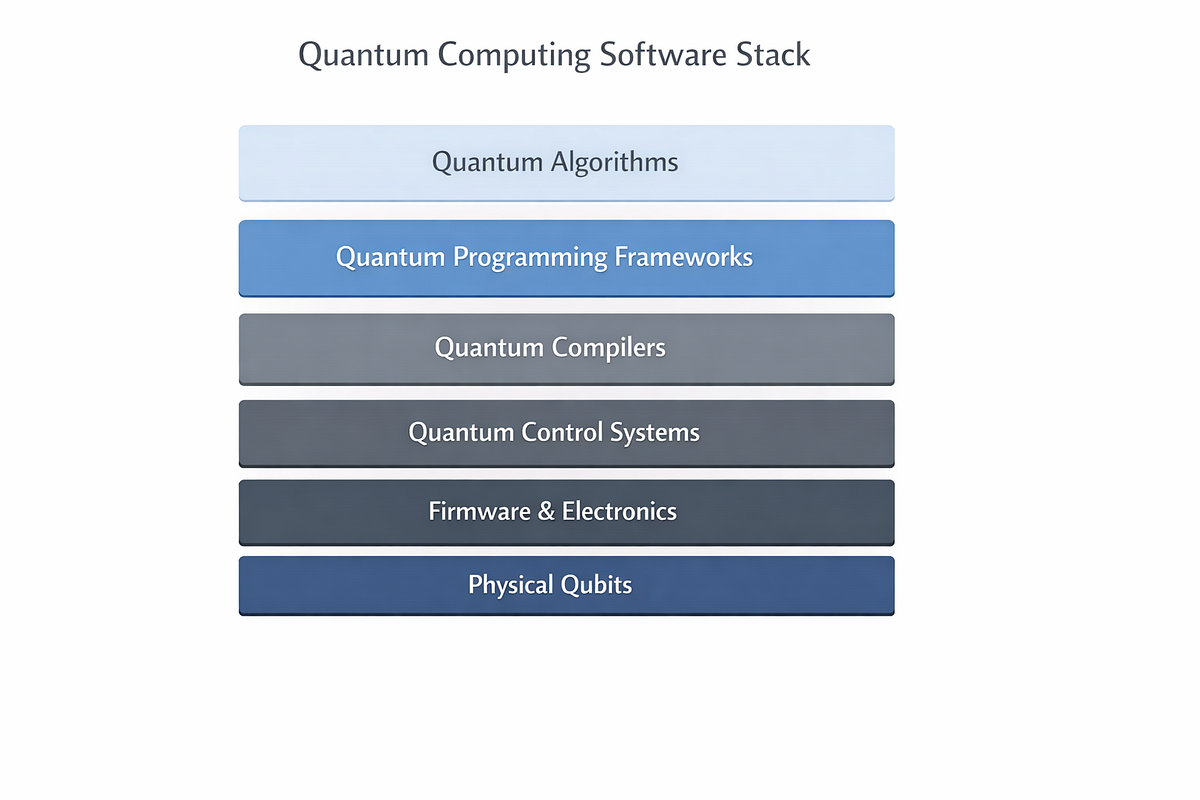
This is why hardware–software co-design is central to quantum computing progress. Advances increasingly come not from isolated breakthroughs, but from coordinated improvements across layers — for example:
- Hardware designs that simplify compilation
- Software techniques that exploit native gate operations
- Adaptive calibration informed by runtime feedback
Quantum computing rewards systems thinking far more than isolated optimization.
Architectural Diversity Is a Feature, Not a Bug
Public discourse often seeks a “winning” qubit technology. In reality, architectural diversity is one of the field’s strengths.
Different qubit modalities impose different trade-offs:
- Superconducting qubits emphasize fast gates and mature fabrication, but face cryogenic and scaling challenges
- Trapped ions offer excellent coherence and connectivity, but trade off speed and system complexity
- Photonic and neutral-atom approaches introduce alternative scaling and networking possibilities
From a systems perspective, these differences shape everything from control electronics to software abstractions. It is unlikely that a single architecture will dominate across all applications in the near term.
Instead, multiple platforms will coexist, each optimized for specific constraints and use cases. This mirrors the evolution of classical computing, where CPUs, GPUs, FPGAs, and specialized accelerators all play complementary roles.
System-Level Bottlenecks and Failure Modes
Evaluating quantum computing systems reveals recurring bottlenecks that transcend specific hardware platforms:
Error Accumulation
Noise compounds rapidly with circuit depth, limiting practical algorithms even on relatively large devices.
Control and Calibration Drift
Maintaining precise control over many qubits requires continuous calibration. Drift can silently degrade performance.
Scaling Control Infrastructure
As systems grow, control electronics and cryogenics become dominant constraints.
Software–Hardware Mismatch
Algorithms designed without hardware awareness often fail in practice.
These challenges reinforce a central lesson: quantum computing is a systems engineering problem before it is a physics problem.
Fault Tolerance: Engineering Meets Architecture
Fault-tolerant quantum computing is often presented as a single milestone. In reality, it is a long-term systems transition.
Progress will require:
- Incremental engineering improvements in qubit quality and control
- Architectural advances such as error-correcting codes and modular designs
- Software capable of managing enormous overhead
No single breakthrough will deliver fault tolerance in isolation. Success depends on coordinated optimization across hardware, architecture, and software.
Realistic Timelines and Near-Term Value
A pragmatic view of quantum computing emphasizes incremental impact rather than sudden disruption:
- Scientific advantage is likely to emerge first in narrow domains such as chemistry and materials science
- Commercial advantage may follow in specialized hybrid workflows over the next decade
- Broad enterprise adoption will require fault-tolerant, cost-effective systems and remains a longer-term prospect
In the near term, the greatest value of quantum computing lies in experimentation, system learning, and ecosystem development.
Under-Discussed Constraints: Talent, Supply Chains, and Policy
Beyond technical challenges, several ecosystem factors will shape quantum computing’s trajectory:
- Talent shortages in cross-disciplinary system expertise
- Supply-chain constraints for specialized materials and components
- Policy and regulatory uncertainty, particularly around cryptography and export controls
These factors are as critical as qubit fidelity in determining how quickly quantum systems move from research to real-world impact.
Conclusion: Quantum Computing Is a Systems Discipline
Quantum computing is not defined by qubits alone. It is defined by the system that enables fragile quantum states to be created, controlled, and integrated into classical workflows.
Progress will favor those who think holistically — who understand trade-offs, constraints, and co-design across layers. As with every major computing paradigm shift, the winners will not be those who chase a single metric, but those who build balanced, well-integrated systems.
Quantum computing’s future will be shaped less by hype and more by systems engineering.
FAQ
Where can I learn the mathematical foundations of quantum computing?
Textbooks and courses on linear algebra, quantum mechanics, and quantum information theory provide the formal mathematical background. This article intentionally focuses on systems-level intuition rather than derivations.
Will quantum computers replace classical computers?
No. Quantum computers are specialized accelerators that complement classical systems rather than replace them.


Comments
Post a Comment