Architecture and Fundamentals of Quantum Computing Systems
Why system integration — not qubit counts — will determine real progress
Introduction: Quantum Computing Is a Systems Problem, Not a Physics Demo
Quantum computing is often introduced through its most exotic elements: qubits in superposition, entanglement defying classical intuition, and algorithms that promise exponential speedups. While these concepts are foundational, they represent only a fraction of what determines whether a quantum computer is useful in practice.
Modern quantum computers are not standalone machines that replace classical systems. They are deeply hybrid, vertically integrated computing platforms, where fragile quantum hardware operates in tight coordination with classical control electronics, orchestration software, and high-performance computing (HPC) resources. As a result, real progress in quantum computing is increasingly driven less by isolated qubit breakthroughs and more by system-level architecture and integration.
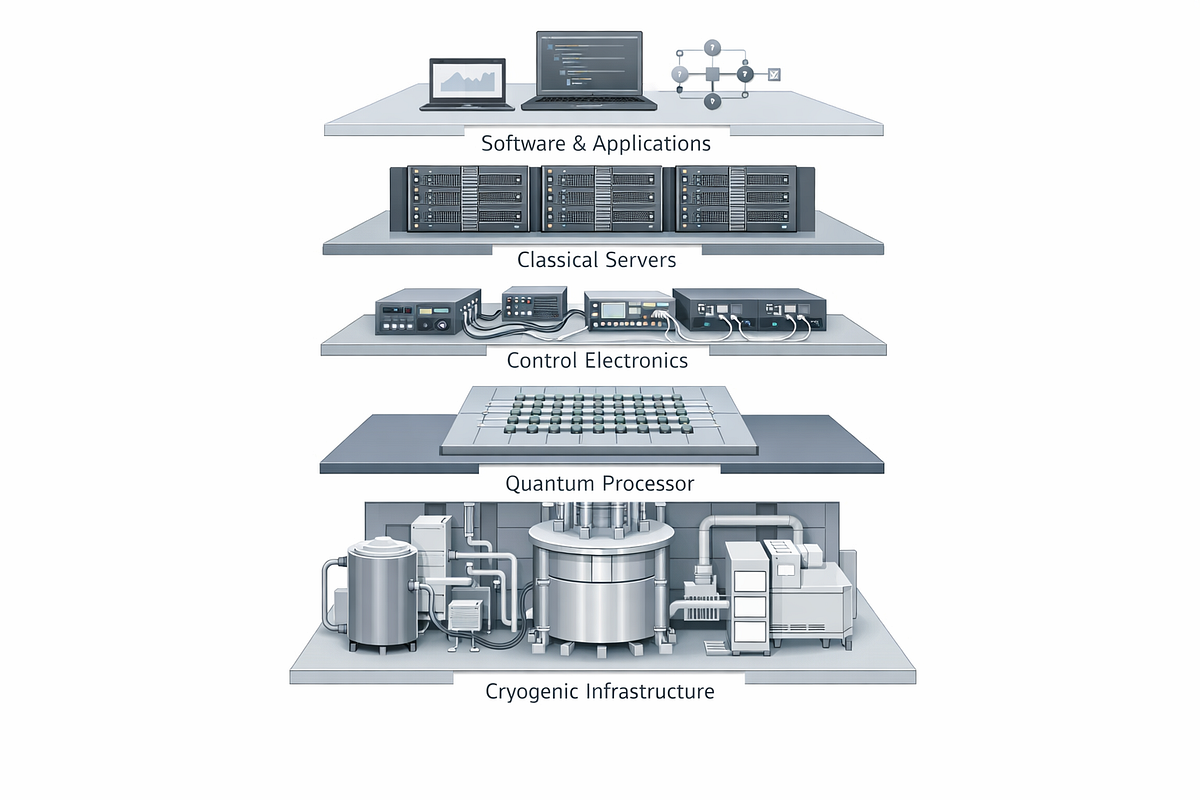
This article examines quantum computing from that systems perspective. It explains the fundamental principles that matter for computation, explores how different quantum architectures are built, and highlights why control layers, cryogenics, software stacks, and orchestration dominate near-term performance. Along the way, it challenges several persistent misconceptions and outlines a realistic path forward for NISQ-era and future systems.
1. Fundamental Quantum Concepts — Explained for System Architects
Quantum computing fundamentals are often taught from a physics-first perspective. For architects and engineers, what matters is how these concepts constrain and shape system design.
Qubits and Superposition
A classical bit is either 0 or 1. A qubit can exist in a superposition of both states, often written as:
α|0⟩ + β|1⟩
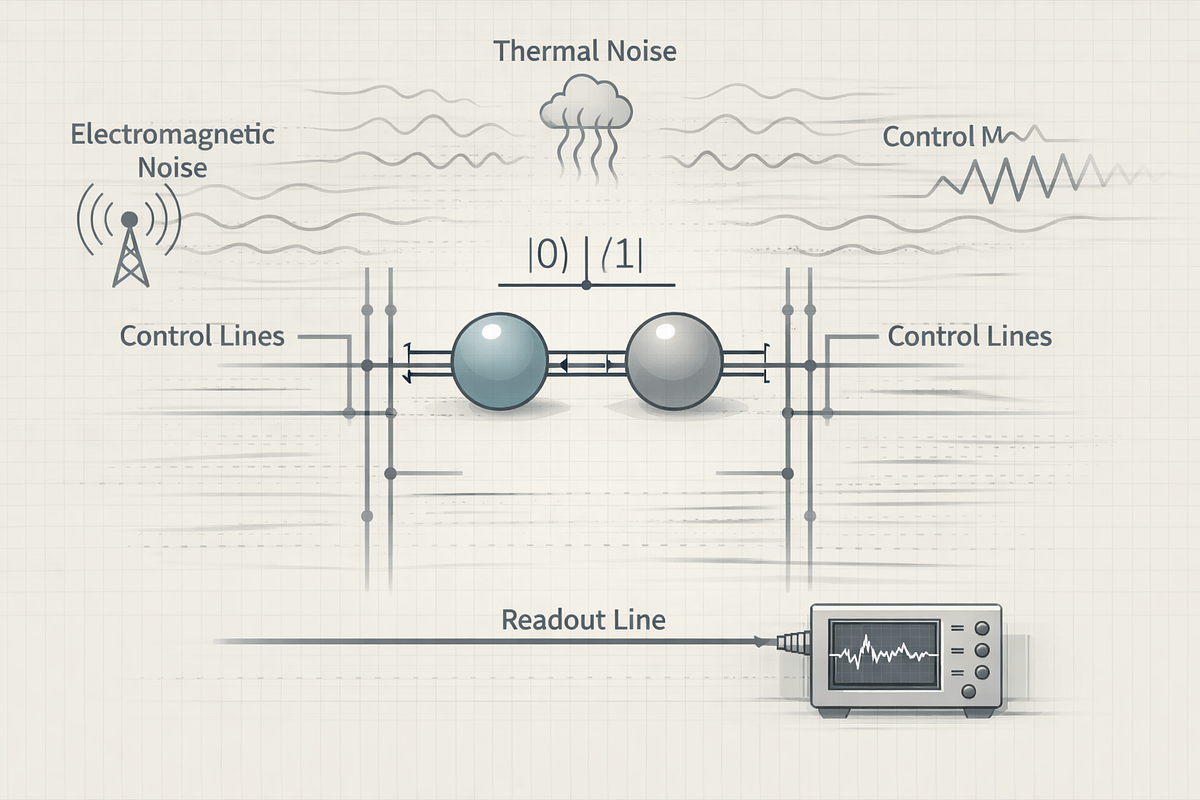
From a systems standpoint, superposition enables parallel state exploration, but it also introduces fragility. Superposition is easily disrupted by environmental noise, which means qubits must be isolated, cooled, and actively controlled. This directly drives architectural requirements such as cryogenics, shielding, and precise timing control.

Entanglement as an Architectural Resource
Entanglement creates strong correlations between qubits that cannot be replicated classically. It is essential for most quantum algorithms — but it also imposes connectivity requirements.
Architectural implication:
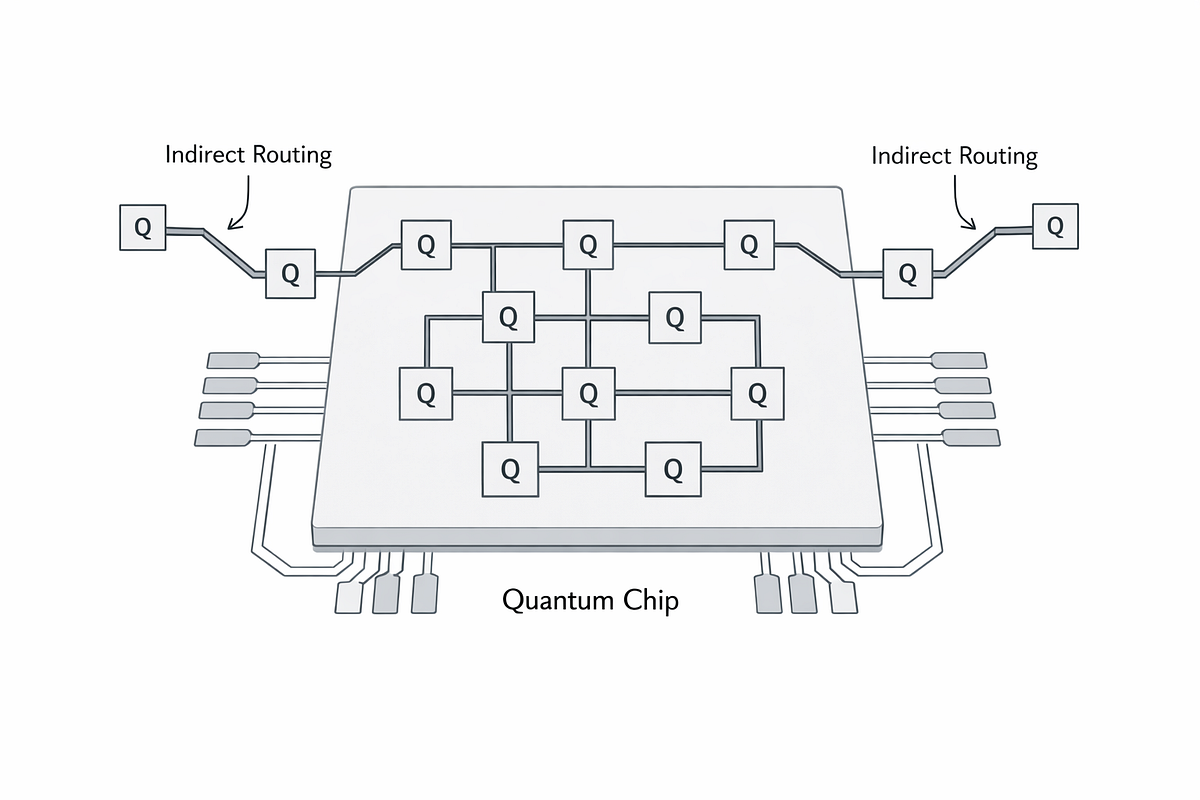
If two qubits cannot be directly entangled due to hardware topology, the system must insert additional operations (e.g., SWAP gates), increasing circuit depth and error accumulation. As a result, connectivity graphs often matter more than raw qubit counts.
Measurement and Collapse
Measurement converts fragile quantum states into classical data, collapsing the superposition. From a systems perspective, this means:
- Quantum computation is probabilistic
- Results require repeated sampling
- Classical post-processing is mandatory
Measurement latency and fidelity are therefore first-class architectural concerns, tightly coupled to control electronics and readout hardware.
Gates, Circuits, and Depth
Quantum gates manipulate qubits over time, forming circuits. The deeper the circuit, the more opportunities for error.
Architectural takeaway:
Coherence time and gate fidelity directly limit the maximum useful circuit depth, making compiler optimization, qubit mapping, and error mitigation essential parts of the system — not optional software layers.
2. Quantum Noise, Decoherence, and Why Error Dominates Everything
Noise is not a secondary concern in quantum computing — it is the dominant constraint.
Decoherence arises from unavoidable interactions with the environment: thermal noise, electromagnetic interference, material defects, and imperfect control signals. Unlike classical systems, quantum errors accumulate continuously, not just at discrete failure points.
From an architectural perspective:
- Error rates scale with system size
- Control precision becomes harder as qubit counts grow
- Stability and calibration overhead increase nonlinearly
This is why fault tolerance, while theoretically sound, remains a long-term goal. The physical and architectural overhead required to support logical qubits is far beyond what near-term systems can support.
3. Quantum Hardware Architectures: A Comparative View
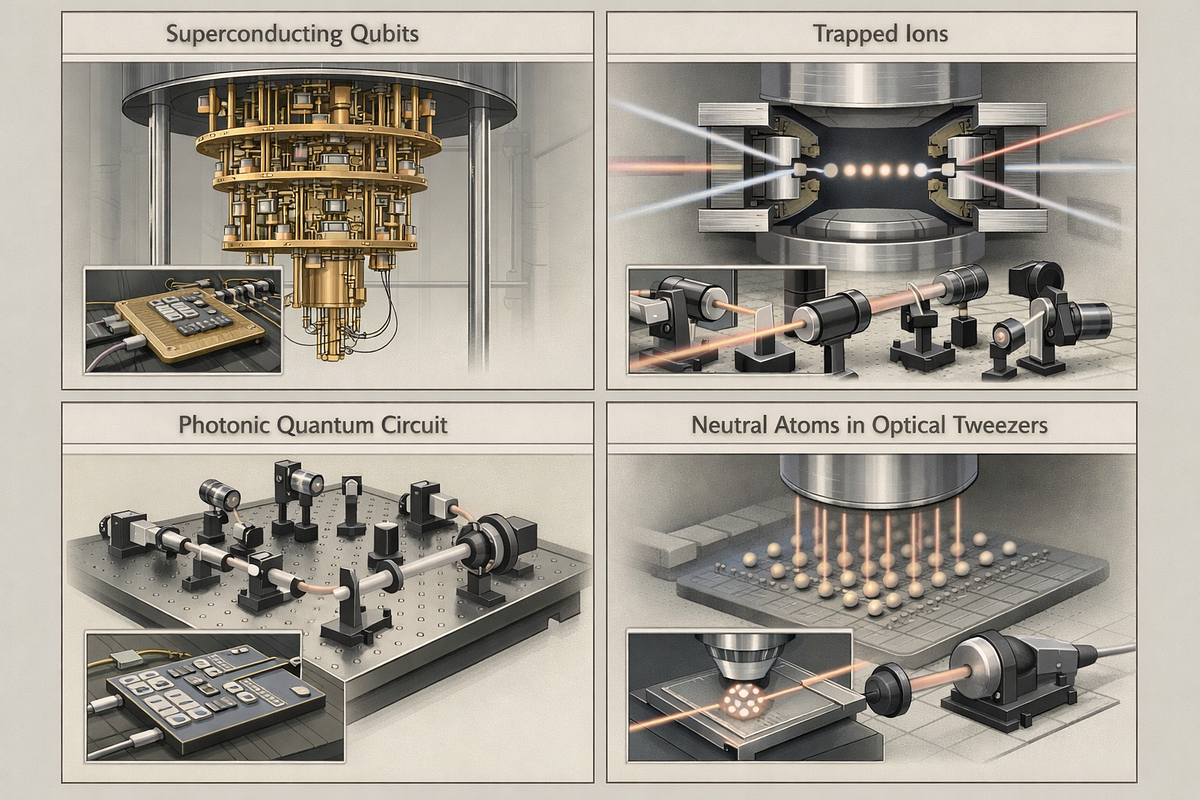
There is no single “quantum computer design.” Different qubit technologies impose fundamentally different architectural constraints.
Superconducting Qubits
Strengths
- Fast gate times (nanoseconds)
- Strong commercial momentum
- Mature tooling and ecosystems
Architectural constraints
- Requires dilution refrigerators (millikelvin temperatures)
- Limited connectivity
- High control electronics complexity
Superconducting systems currently dominate cloud-accessible quantum platforms, but scaling them is as much a cryogenic and wiring problem as a qubit problem.
Trapped Ion Qubits
Strengths
- Long coherence times
- High gate fidelity
- Flexible, often all-to-all connectivity
Architectural constraints
- Slower gate speeds
- Complex laser and optical control systems
- Scaling introduces mechanical and optical challenges
Photonic Systems
Strengths
- Operate at or near room temperature
- Naturally suited for quantum communication
Architectural constraints
- Difficult deterministic two-qubit gates
- Challenging error correction
- Still emerging for general-purpose computation
Neutral Atoms
Strengths
- Flexible qubit placement
- Potential for large arrays
Architectural constraints
- Gate fidelity is still improving
- Control complexity increases with scale
Key takeaway
Different architectures optimize different trade-offs. Claims that one modality has “won” misunderstand the reality: quantum architecture is use-case driven, not universally convergent.
4. The Often-Ignored Layers: Control Systems and Cryogenics
Quantum computing performance is increasingly determined by layers that rarely appear in headlines.
Control Electronics
Control systems generate precisely shaped pulses, synchronize operations, and provide real-time feedback. Small imperfections here translate directly into gate errors.
In practice, control electronics act as the “nervous system” of the quantum computer. As systems scale, control complexity often grows faster than qubit counts.
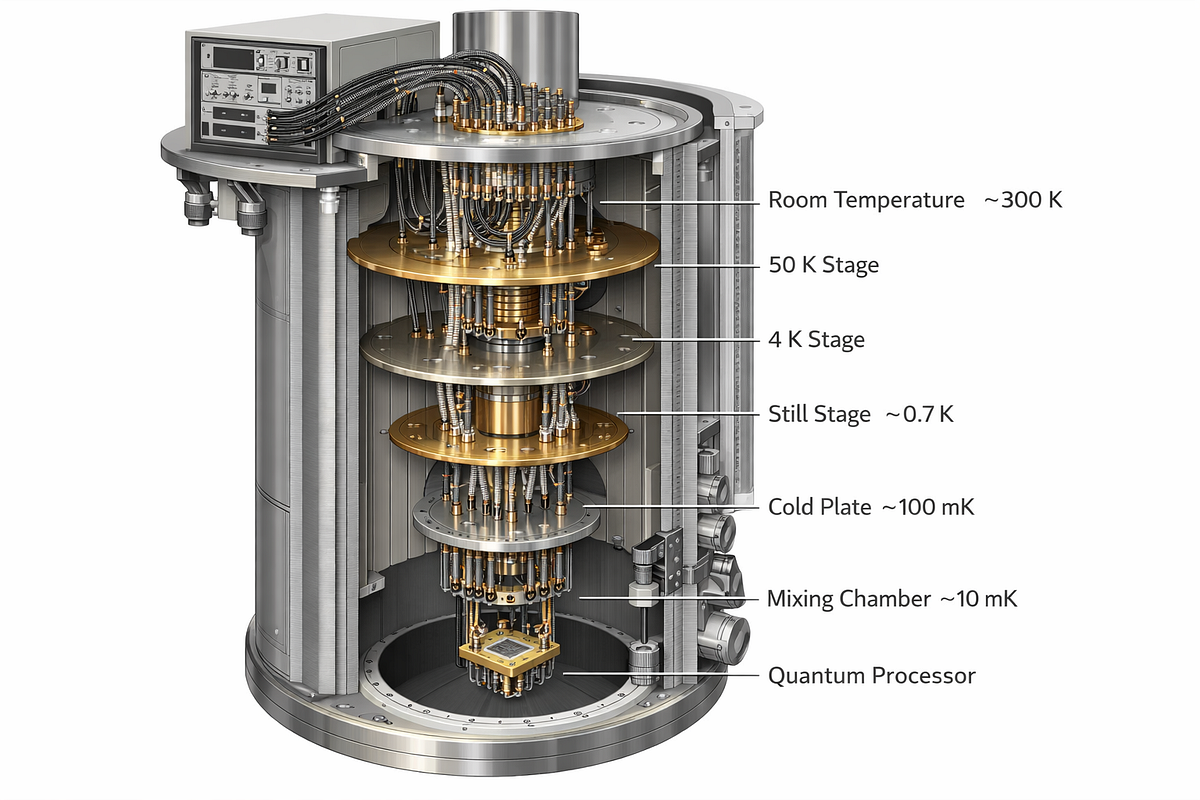
Cryogenics
For superconducting systems, cryogenics refers to:
- Physical layout
- Wiring density
- Cost
- Reliability
Cooling thousands or millions of qubits is not simply a physics challenge — it is a major systems engineering problem involving thermal gradients, mechanical stability, and signal integrity.
5. Hybrid Classical–Quantum Architecture: The Real Computing Model
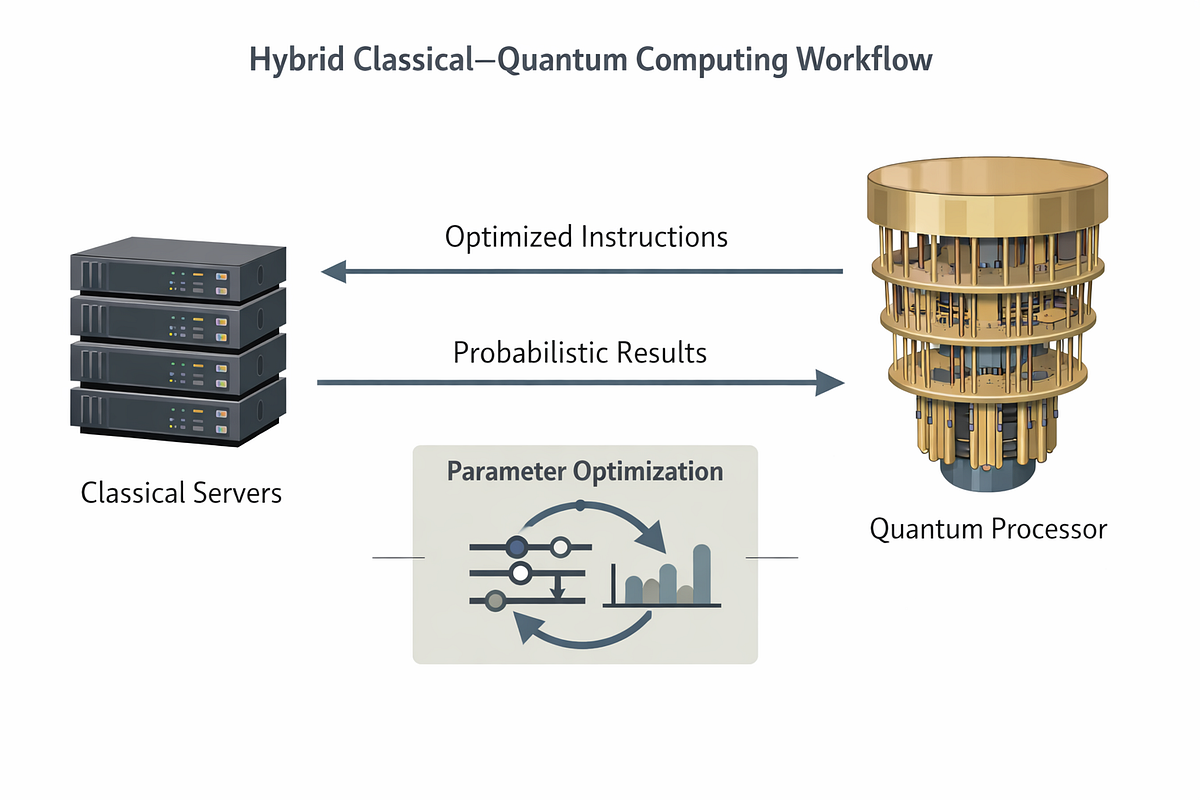
Every useful quantum computation today is hybrid.
A simplified execution flow looks like this:
Quantum Application
→ Classical Compiler & Optimizer
→ Qubit Mapping & Scheduling
→ Control Pulse Generation
→ Quantum Execution
→ Measurement
→ Classical Post-Processing
→ Iteration / Optimization Loop
Classical systems handle:
- Compilation and optimization
- Error mitigation
- Parameter tuning
- Result interpretation
Architecturally, this means quantum computers function as specialized accelerators, not general-purpose machines. Their success depends on how well they integrate into existing HPC and cloud environments.
6. Software Stacks and Frameworks: Abstractions with Sharp Edges
Quantum software remains tightly coupled to hardware.
Frameworks such as Qiskit, Cirq, and Braket reflect different priorities, but none fully abstract away hardware constraints. Topology, noise profiles, and native gate sets still leak through every layer.
This is not a failure of tooling — it is an architectural reality. Until fault-tolerant systems exist, quantum computing will remain vertically integrated, requiring developers and architects to understand the underlying hardware.
7. Where Theory Meets Reality: Practical Lessons from Real Systems
Two recurring system-level lessons stand out in practice.
Connectivity matters more than expected.
Algorithms designed with idealized, all-to-all connectivity often perform poorly when mapped to real hardware, where additional routing operations dramatically increase noise.
Orchestration dominates wall-clock time.
Queueing delays, calibration windows, and classical preprocessing frequently outweigh raw quantum execution time. Performance is a function of the entire pipeline, not gate speed alone.
These gaps between theory and practice reinforce the central point: quantum computing is an engineering discipline as much as a scientific one.
8. Fault Tolerance, NISQ, and Realistic Timelines
Fault-tolerant quantum computing remains a long-term objective, likely decades away for general-purpose machines. The near and medium term belong to NISQ systems, where value emerges from careful co-design:
- Algorithms tailored to hardware constraints
- Error mitigation instead of full correction
- Tight classical–quantum integration
Practical quantum advantage is likely to appear first in narrow domains — chemistry, materials, optimization — where hybrid workflows can outperform classical methods on specific problems.
Conclusion: Architecture Is the Differentiator
Quantum computing will not be won by the organization with the most qubits, the boldest roadmap, or the most optimistic press releases. It will be shaped by teams that understand quantum computers as complex, integrated systems.
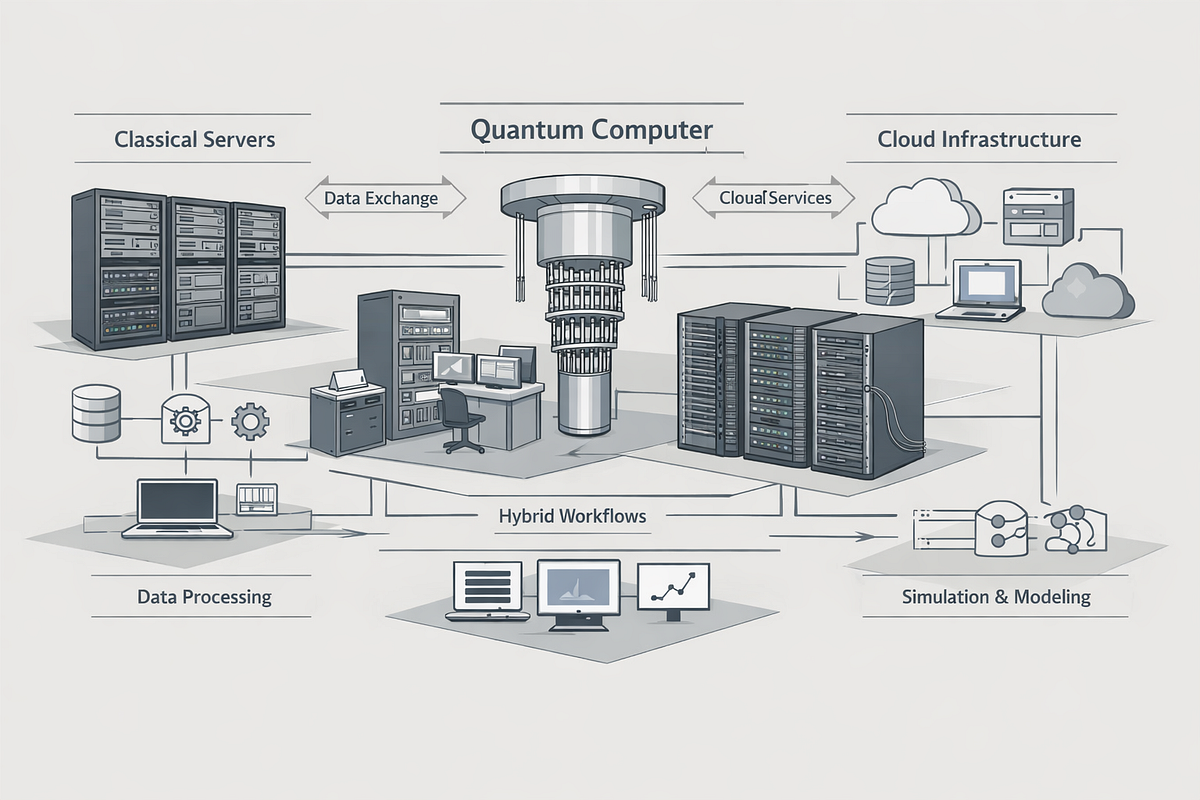
The real progress is happening where hardware, control, software, and classical infrastructure evolve together. In that sense, quantum computing’s future looks less like a sudden revolution and more like a familiar story from classical HPC: steady, system-driven engineering progress that rewards architectural discipline over hype.
For engineers, architects, and decision-makers, this perspective is not just more realistic — it is essential for making informed investments and meaningful technical contributions in the quantum era.


Comments
Post a Comment