Demystifying Quantum Computing Systems
Quantum computing is often described as revolutionary, inevitable, and just around the corner. At the same time, it is also described as fragile, experimental, and decades away from usefulness. Both narratives contain elements of truth — and both can be misleading without the right context.
If you are a technical reader, an engineer from a classical background, or an executive trying to separate signal from noise, the real question is not “Is quantum computing the future?” It is:
What is a quantum computing system actually capable of today, and how should we think about it realistically?
This article provides a systems-level explanation — not physics formalism, and not marketing hype.
What Is a Quantum Computing System, Really?
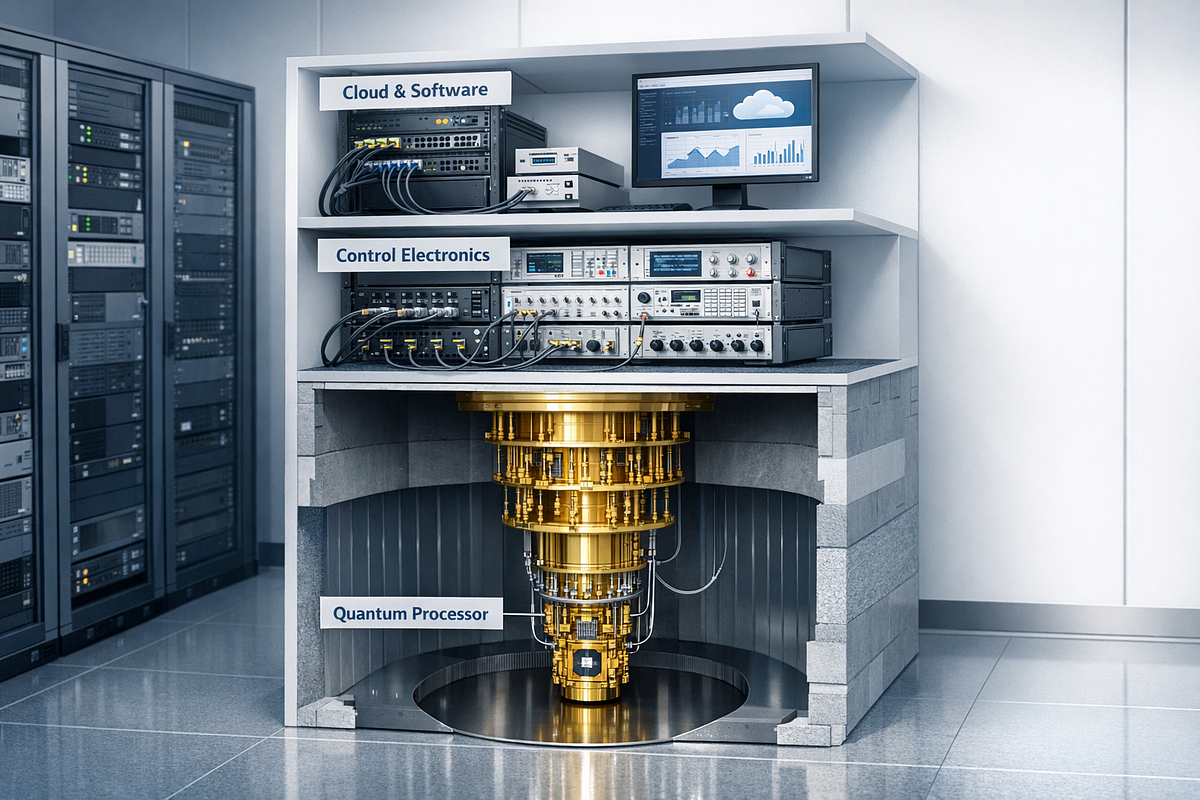
When people ask how quantum computers work, they often focus only on qubits. In reality, a quantum computing system is a full stack, more comparable to a data center than to a single chip.
At a high level, a modern quantum system includes:
- Quantum processor (QPU) — Where qubits live, and quantum operations occur
- Control electronics — Classical hardware that sends precisely timed signals to manipulate qubits
- Cryogenic or vacuum infrastructure — Extreme environments required to keep qubits stable
- Classical compute layer — Optimizers, error mitigation routines, and hybrid algorithms
- Software stack and SDKs — Tools like Qiskit or Cirq that allow developers to design circuits
So when we talk about quantum computing, we are not just talking about exotic physics. We are talking about complex hybrid systems where classical and quantum components are deeply interdependent.
Qubits Are Not “Better Bits”
You will often hear that a qubit can be “0 and 1 at the same time.” While this is directionally helpful, it hides the real story.
A more useful mental model is this:
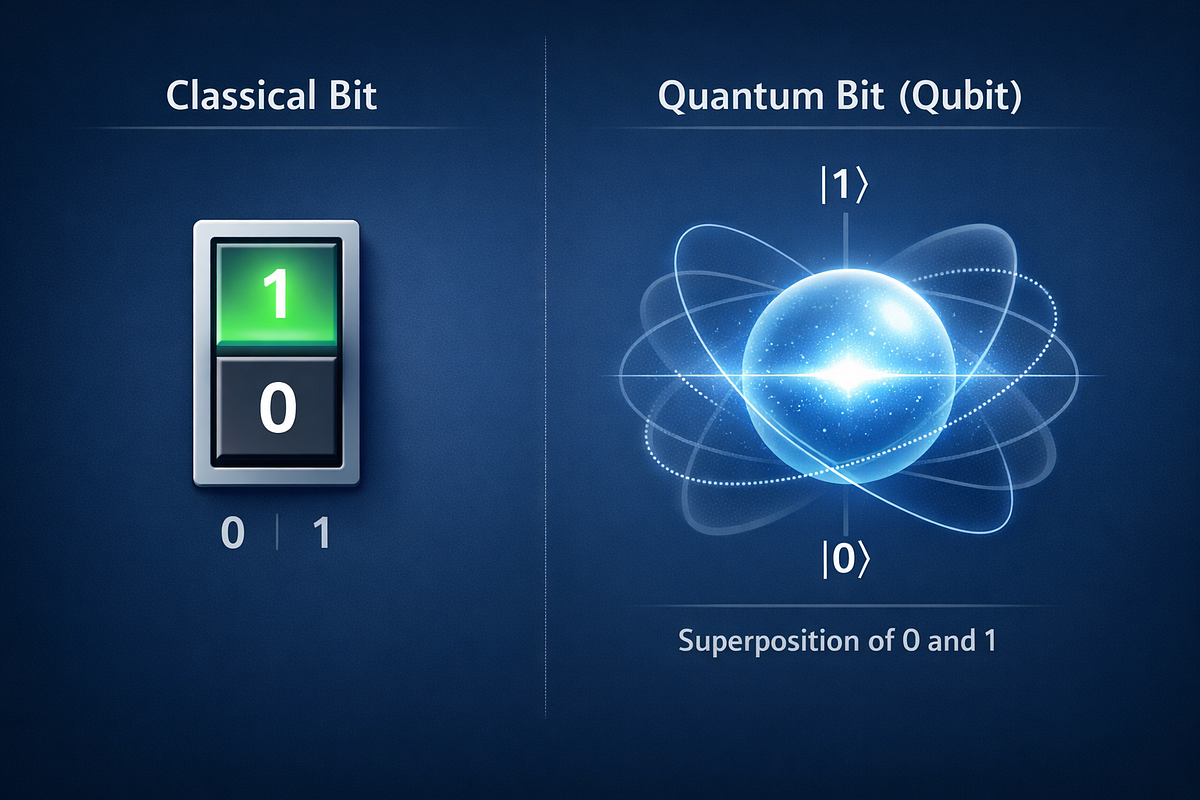
A classical bit is like a coin lying flat on a table — heads or tails.
A qubit is more like a spinning coin. While spinning, it doesn’t have a fixed value. Instead, it represents a set of probabilities that only resolve when you stop it and look.
Two additional properties make qubits powerful:
- Superposition — Qubits represent probability distributions, not fixed states
- Entanglement — Qubits can become correlated in ways classical bits cannot
- Interference — Quantum algorithms amplify correct answers and cancel out wrong ones
The key takeaway is this:
Quantum computers are not just faster classical machines. They process information in a fundamentally different way, and only certain problems can take advantage of that.
Why Noise Changes Everything
In theory, quantum systems are extraordinarily powerful. In practice, they are extraordinarily fragile.
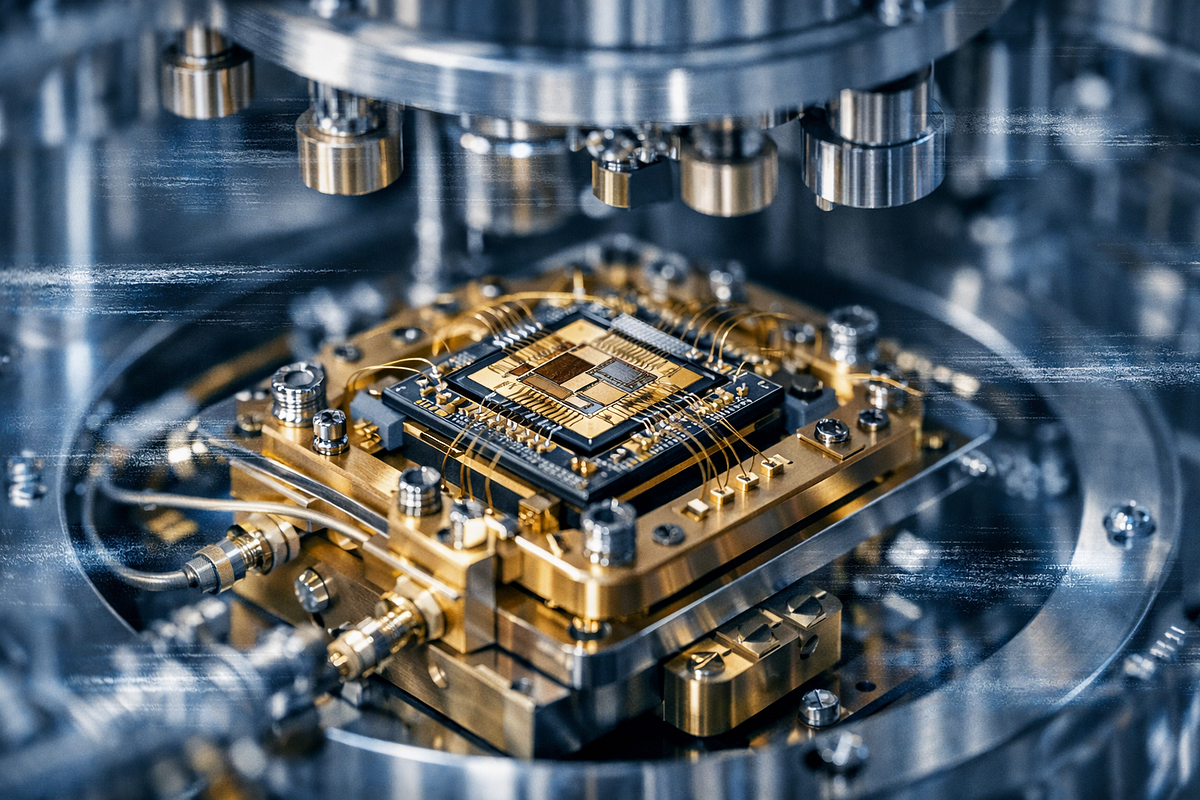
Qubits are highly sensitive to their environment. Tiny disturbances — heat, electromagnetic noise, material defects — introduce errors into calculations. This is why today’s systems are called NISQ devices (Noisy Intermediate-Scale Quantum).
This has major implications:
- Circuits must be short, or errors accumulate
- More qubits do not automatically mean better performance
- Error correction requires many physical qubits to create one reliable “logical” qubit
In every evaluation I have been involved in, error rates and system stability matter far more than raw qubit counts. A 1,000-qubit system with high noise may be less useful than a smaller, more stable one.
Common Myths About Quantum Computing
Let us address several persistent misconceptions.
Myth 1: Quantum computers will replace classical computers
They will not. Quantum computers are special-purpose accelerators, similar to how GPUs accelerate graphics and AI workloads. Most business computing — databases, web services, analytics — will remain classical.

Myth 2: Quantum advantage is already here
Some research experiments have shown “quantum advantage” on highly specialized benchmarks. However, many of these tasks are:
- Artificial
- Economically irrelevant
- Quickly matched by improved classical algorithms
For real-world problems, broad quantum advantage remains limited.
Myth 3: More qubits mean better performance
This is one of the most misleading narratives in the field. System quality — gate fidelity, coherence time, connectivity, and error mitigation — is often more important than qubit count.
Myth 4: Quantum computing is just faster computing
It is not simply about speed. Problems must be reformulated to take advantage of quantum behavior. Many workloads do not map efficiently to quantum systems at all.
Where Quantum Systems Are Showing Promise
Despite the limitations, there are meaningful areas of progress.
1. Quantum Simulation (Chemistry & Materials)
Quantum systems are naturally suited to simulating quantum phenomena. Small-scale experiments using hybrid algorithms (such as VQE) have demonstrated that quantum devices can approximate properties of simple molecules.
These are not industrial breakthroughs yet, but they validate the direction of research.
2. Optimization (With Caveats)
Quantum approaches to optimization — including QAOA and quantum annealing — have been tested on routing, scheduling, and portfolio problems. In most realistic comparisons I have seen, classical solvers still outperform quantum systems at scale.
However, these efforts are valuable for learning how to encode complex problems into quantum-friendly formats, which is a non-trivial skill.
3. Hybrid Quantum–Classical Workflows
The most productive near-term pattern is not “quantum alone,” but hybrid systems where classical computers handle orchestration and optimization while quantum processors tackle specific subroutines.
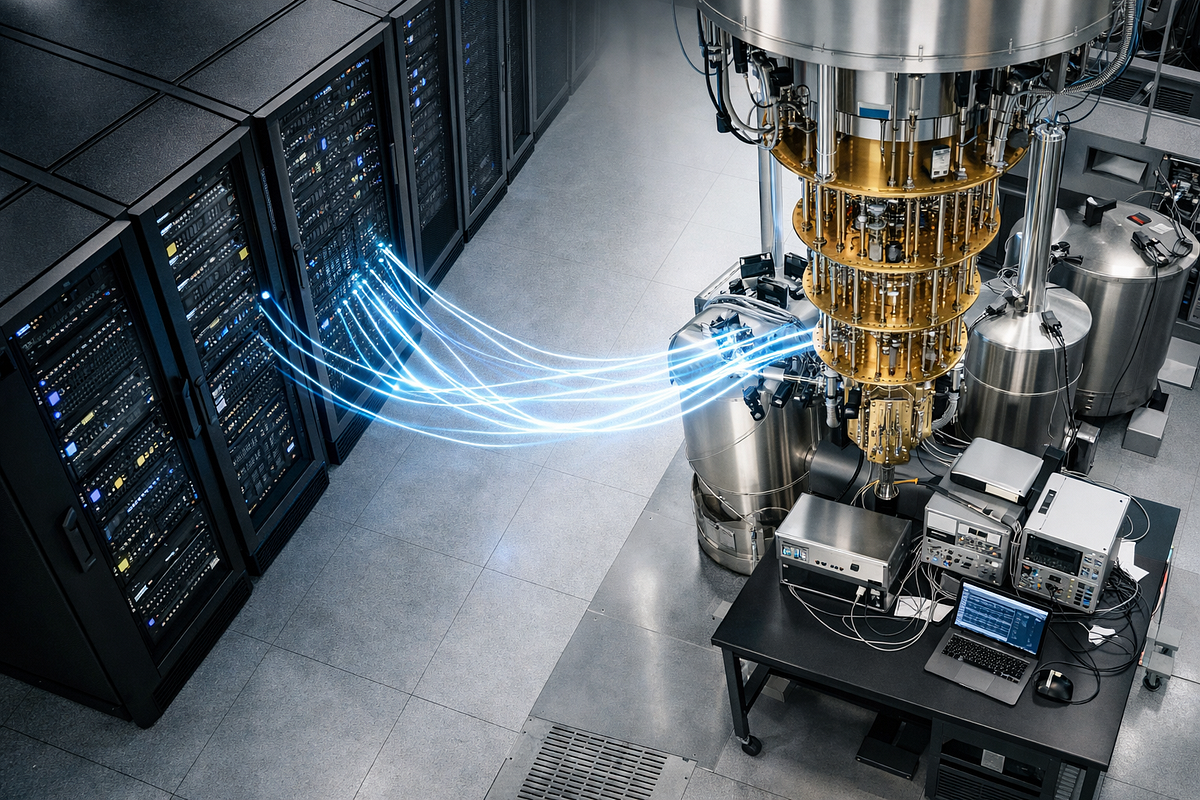
This hybrid model is likely to define quantum computing for years to come.
4. Post-Quantum Cryptography (PQC)
One area with immediate strategic relevance is security planning. Large-scale fault-tolerant quantum computers could eventually break today’s public-key cryptography. Even though that capability is years away, organizations are already preparing by evaluating post-quantum cryptographic standards.
This is a practical example of quantum impact that does not require quantum hardware deployment.
Why Many Early Quantum Initiatives Struggled
Across multiple enterprise and vendor evaluations, several patterns repeat:
- Pilot projects stalled after proof-of-concept because scaling beyond toy problems proved unrealistic
- Teams were formed before clear use cases existed
- Decisions were driven by vendor metrics like qubit counts rather than system performance
- Expectations were set by hype cycles rather than engineering constraints
Most of these efforts did not fail because the teams were unskilled. They failed because expectations outpaced the maturity of the ecosystem.
Understanding the Hardware Landscape
Not all quantum computers are built the same way. The main hardware approaches include:
- Superconducting qubits — Fast operations, used by several major vendors, but require extreme cryogenic environments
- Trapped ions — High fidelity and strong qubit connectivity, typically slower gate speeds
- Photonic systems — Use particles of light; promising for networking and room-temperature operation in some designs
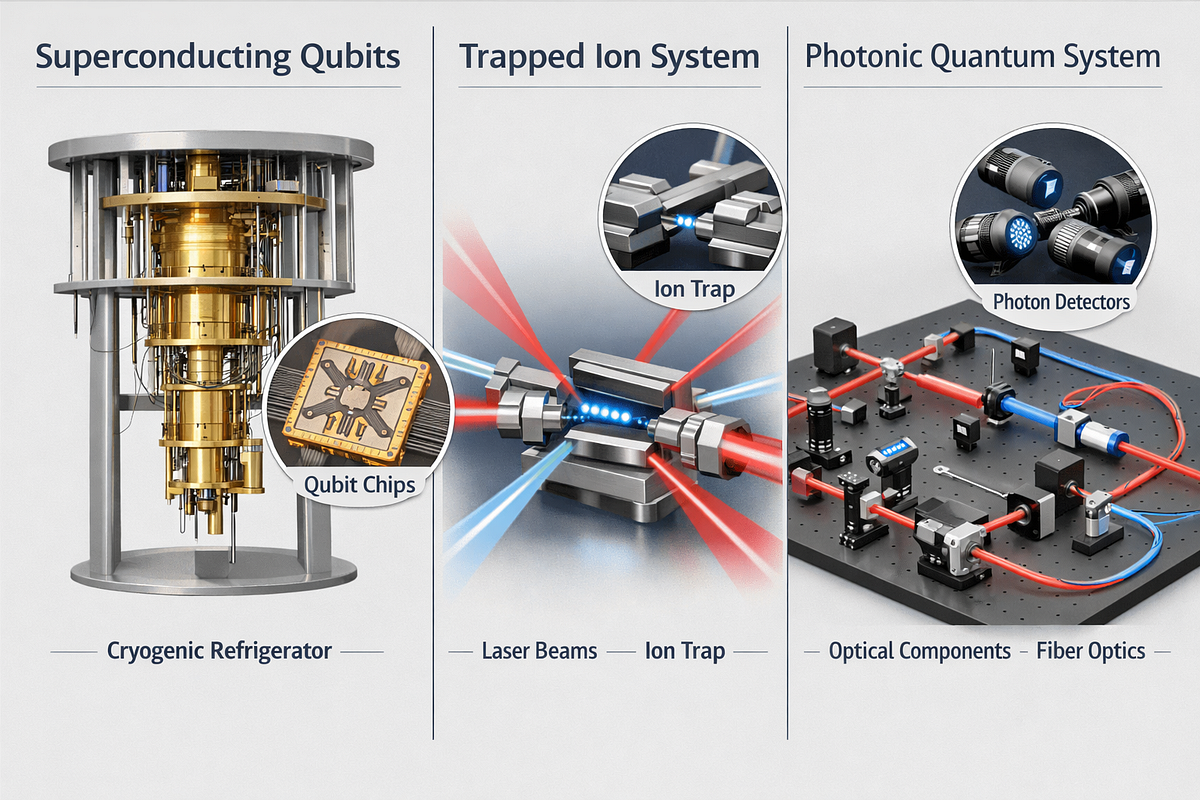
Each approach involves trade-offs between speed, stability, scalability, and engineering complexity. There is no single “winning” architecture yet.
NISQ, QML, and the Reality Check
A few topics deserve particularly sober treatment.
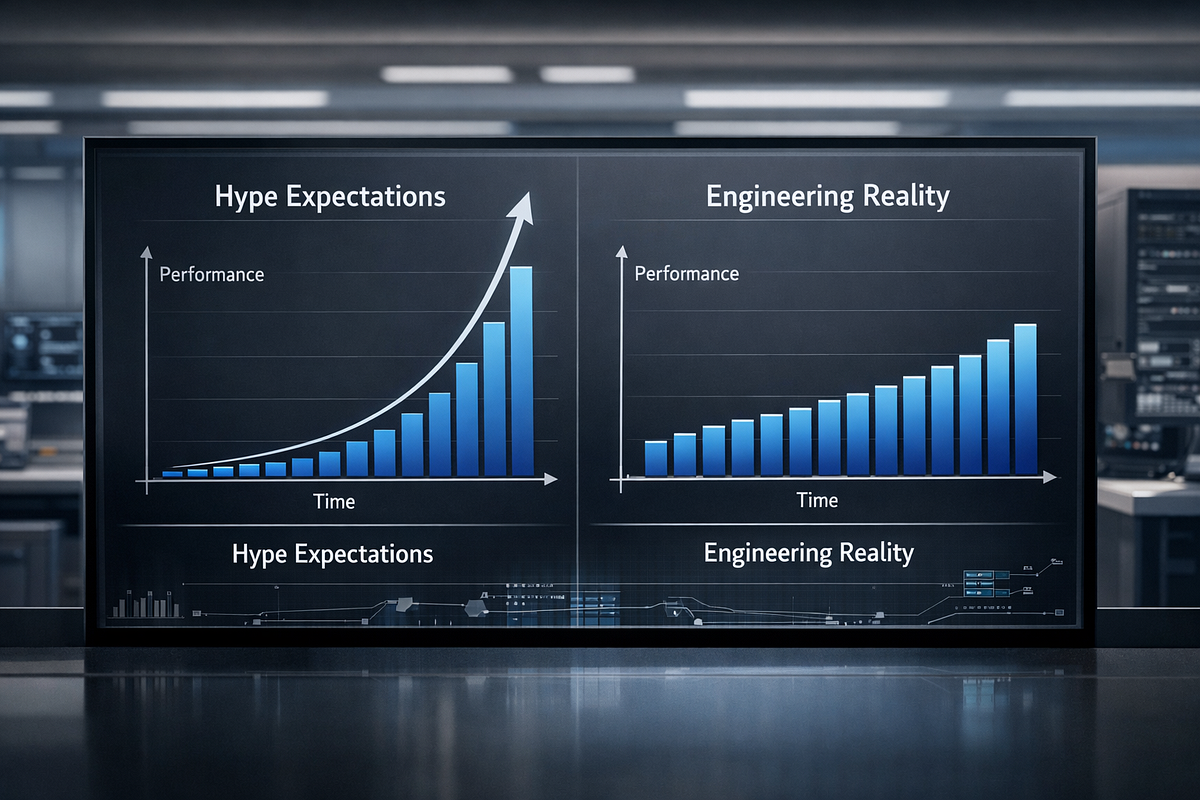
NISQ systems are valuable for experimentation and education, but rarely deliver production-grade business value today.
Quantum machine learning is an active research area, but classical AI hardware and algorithms remain far more capable for real-world data problems.
Error correction, not just scaling qubit numbers, is the true long-term bottleneck. Until logical qubits can be maintained reliably, large-scale quantum advantage will remain limited.
So What Should You Do With This Information?
If you are an executive or technical leader, the most rational stance today is neither dismissal nor blind enthusiasm. It is an informed optionality.
That means:
- Monitoring the field with a critical eye
- Running small, low-risk experiments if you have research-oriented capacity
- Avoiding large capital or hiring commitments without clear, time-aligned use cases
- Beginning post-quantum cryptography planning as part of a long-term security strategy
If you are an engineer, learning the basics of quantum computing systems — especially hybrid workflows — can be a valuable long-term investment, even if immediate applications are limited.
The Bottom Line
Quantum computing is neither magic nor myth. It is an emerging computing paradigm with genuine scientific promise and significant engineering constraints.
Understanding quantum computing systems at a systems level — hardware limits, error rates, hybrid dependencies, and realistic timelines — is the key to separating meaningful progress from marketing noise.
The future of quantum computing will likely be incremental, hybrid, and specialized — not a sudden replacement of classical computing, but a gradual expansion of what is computationally possible.


Comments
Post a Comment