Inside a Quantum Computing System: Components and Operation
Quantum computing is often described in abstract terms — qubits in superposition, algorithms that outperform classical machines, and future breakthroughs that promise transformative impact. What is far less frequently explained is how a quantum computer actually works as a system: how its physical components, classical control infrastructure, software stack, and operational workflows come together to execute a computation in the real world.
This gap matters. Without a correct system-level mental model, it is easy to overestimate near-term capabilities, misunderstand performance bottlenecks, or make poor architectural or strategic decisions. Quantum computing today is not a single breakthrough device; it is a tightly coupled, hybrid system where fragile quantum hardware depends heavily on classical engineering and operational discipline.
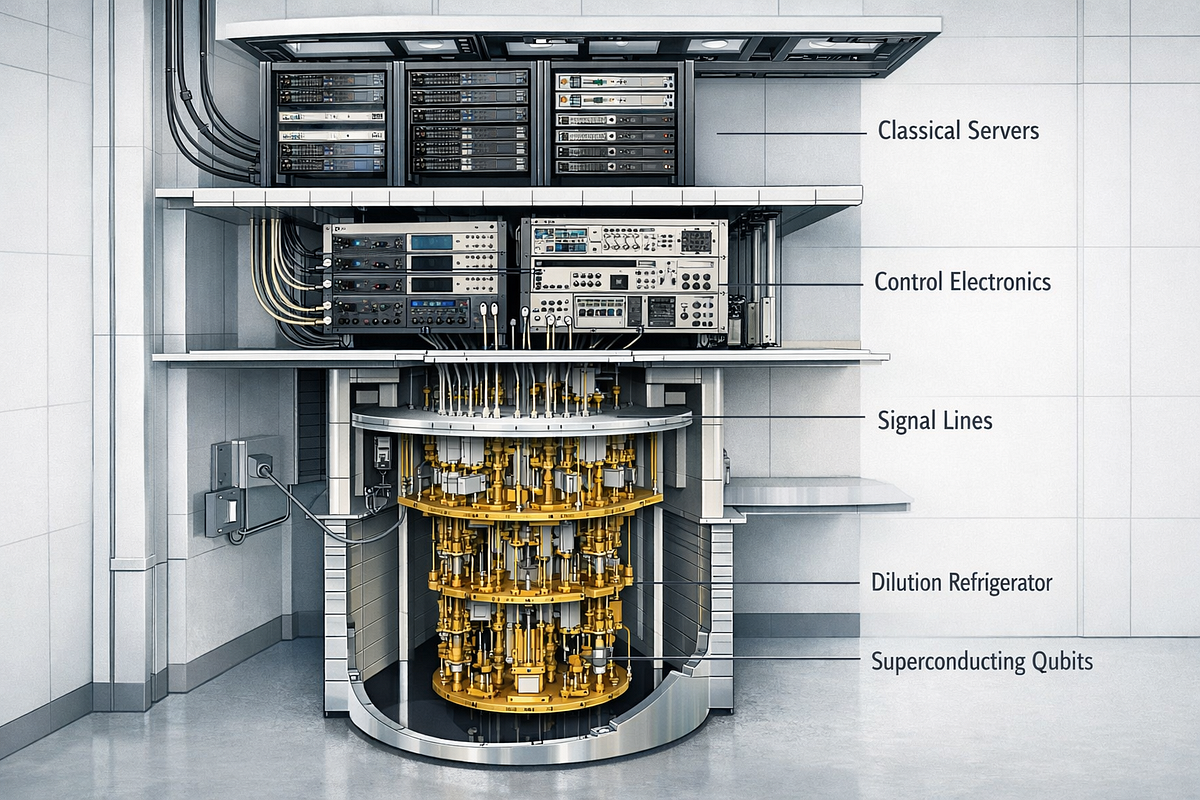
This article takes an “inside the machine room” perspective. Rather than focusing on algorithms or speculative applications, it explains how modern quantum computing systems are built, how they operate end-to-end, and why their real-world behavior often diverges from idealized descriptions. The goal is not to diminish the field’s progress, but to ground expectations in how these systems actually function today.
A Quantum Computer Is a System, Not a Qubit
A common misconception is that quantum computing power scales primarily with qubit count. In practice, qubits are only one component — albeit a critical one — within a much larger system. A functioning quantum computer integrates:
- Physical qubits with finite coherence and nonzero error rates
- High-precision classical control electronics
- Specialized infrastructure, such as cryogenics, vacuum, and laser systems
- Continuous calibration and error mitigation workflows
- A multilayer software stack that translates abstract programs into hardware-specific operations
- Classical computing resources for compilation, scheduling, and post-processing
From a systems perspective, quantum computing looks less like a standalone processor and more like a tightly orchestrated hybrid platform. Quantum hardware performs narrow, fragile operations, while classical systems manage nearly everything else.
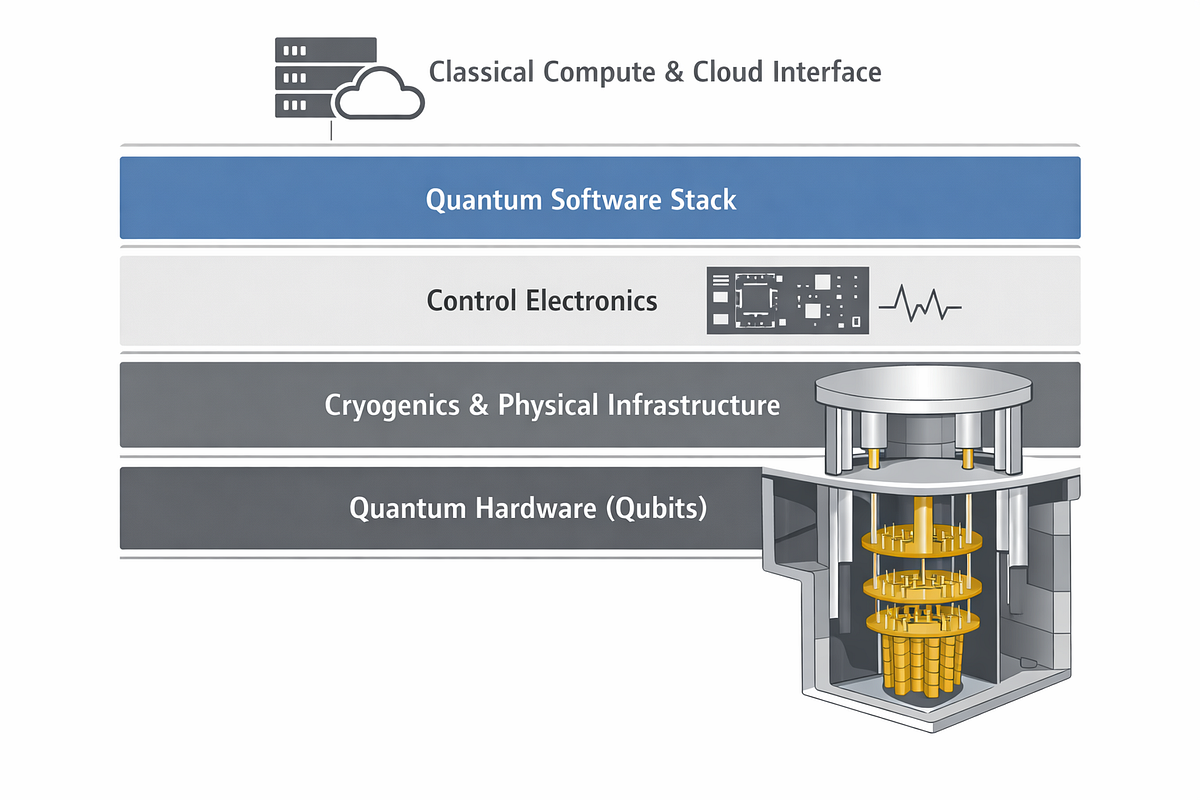
Understanding this division of labor is essential for evaluating current platforms and their realistic capabilities.
Qubits: Capability Is Defined by Quality, Not Count
Qubits are the fundamental information carriers of a quantum computer, but they are far from uniform across platforms. Their practical usefulness depends on several interrelated properties:
- Coherence time: How long a qubit retains its quantum state
- Gate fidelity: How accurately operations can be applied
- Connectivity: Which qubits can interact directly
- Crosstalk and noise sensitivity: How operations on one qubit affect others
In superconducting systems, qubits are implemented using Josephson junction–based circuits operating at millikelvin temperatures. These platforms benefit from fast gate speeds and strong industrial momentum, but face challenges in coherence and connectivity as systems scale.
Trapped-ion systems, by contrast, encode qubits in atomic states manipulated by lasers. They offer high gate fidelity and flexible connectivity, often at the cost of slower gate speeds and more complex optical control.
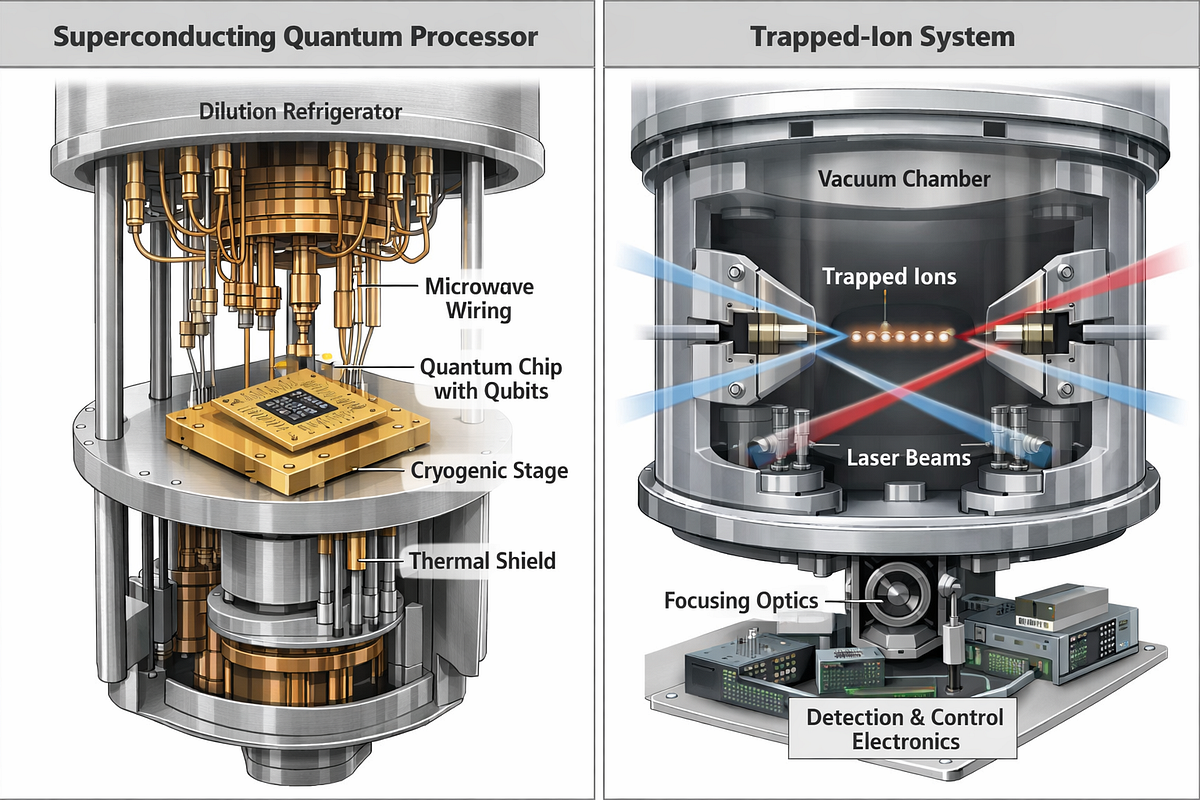
The key takeaway is that “more qubits” does not automatically translate into more computational power. A smaller system with higher fidelity, better connectivity, and lower noise can outperform a larger but noisier one for many workloads. This is why raw qubit counts are a poor proxy for real capability.
Control Electronics: The Hidden Workhorse
Quantum systems do not operate autonomously. Every qubit operation is driven by classical control hardware that generates precisely shaped microwave pulses or laser sequences. These signals must be synchronized, calibrated, and adapted continuously to account for drift and environmental variation.
In superconducting platforms, racks of room-temperature electronics generate control signals that travel through attenuated wiring into cryogenic environments. In trapped-ion systems, laser stabilization, beam steering, and timing precision play a similar role.
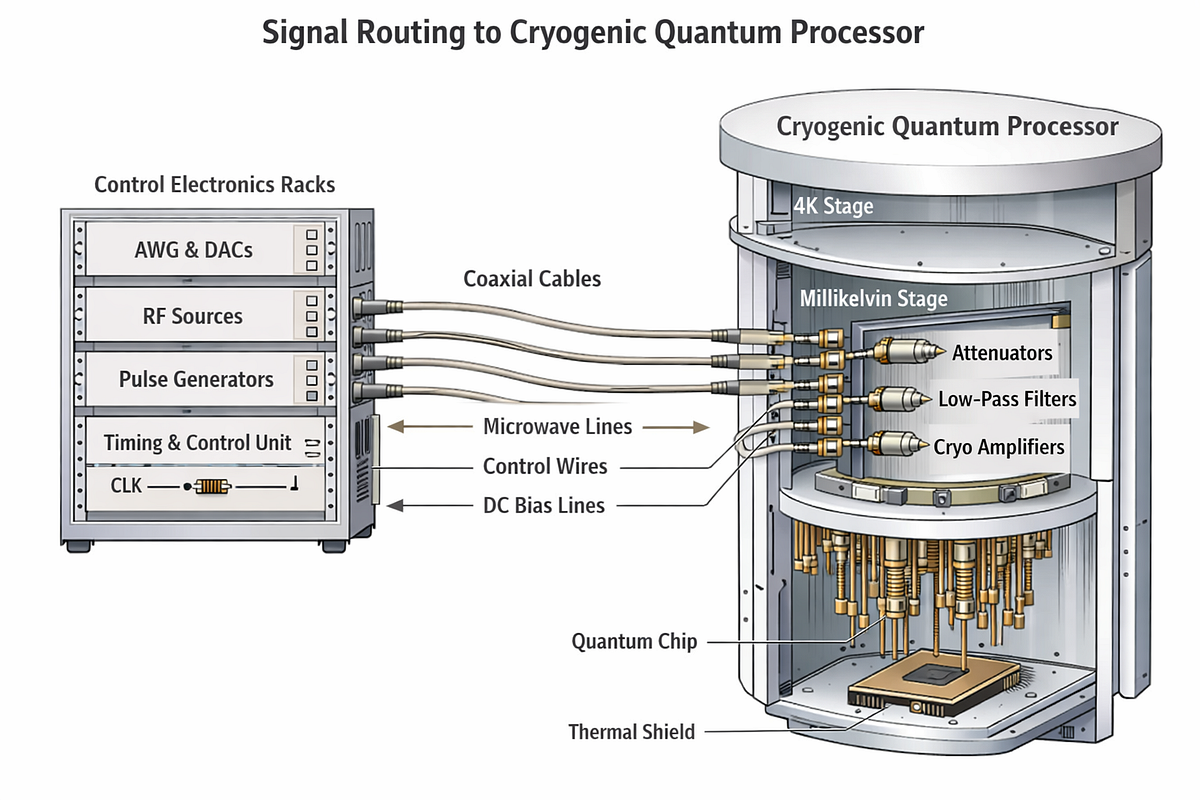
This control layer introduces several important constraints:
- Latency and bandwidth limits affect feedback and adaptive circuits
- Signal distortion degrades gate fidelity
- Scaling complexity grows rapidly with qubit count
From a system design standpoint, control electronics are often the bottleneck long before qubits themselves. Improvements in this layer — modularization, integration, and automation — are as critical as advances in qubit technology.
Cryogenics and Physical Infrastructure: Necessary, Not Optional
For superconducting quantum computers, cryogenics is not a novelty — it is a requirement. Qubits must operate at temperatures close to absolute zero to maintain superconductivity and suppress thermal noise. Achieving and maintaining these conditions requires dilution refrigerators, vibration isolation, and careful thermal engineering.
Trapped-ion systems replace cryogenics with ultra-high vacuum chambers and complex optical setups, trading thermal challenges for mechanical and optical ones.
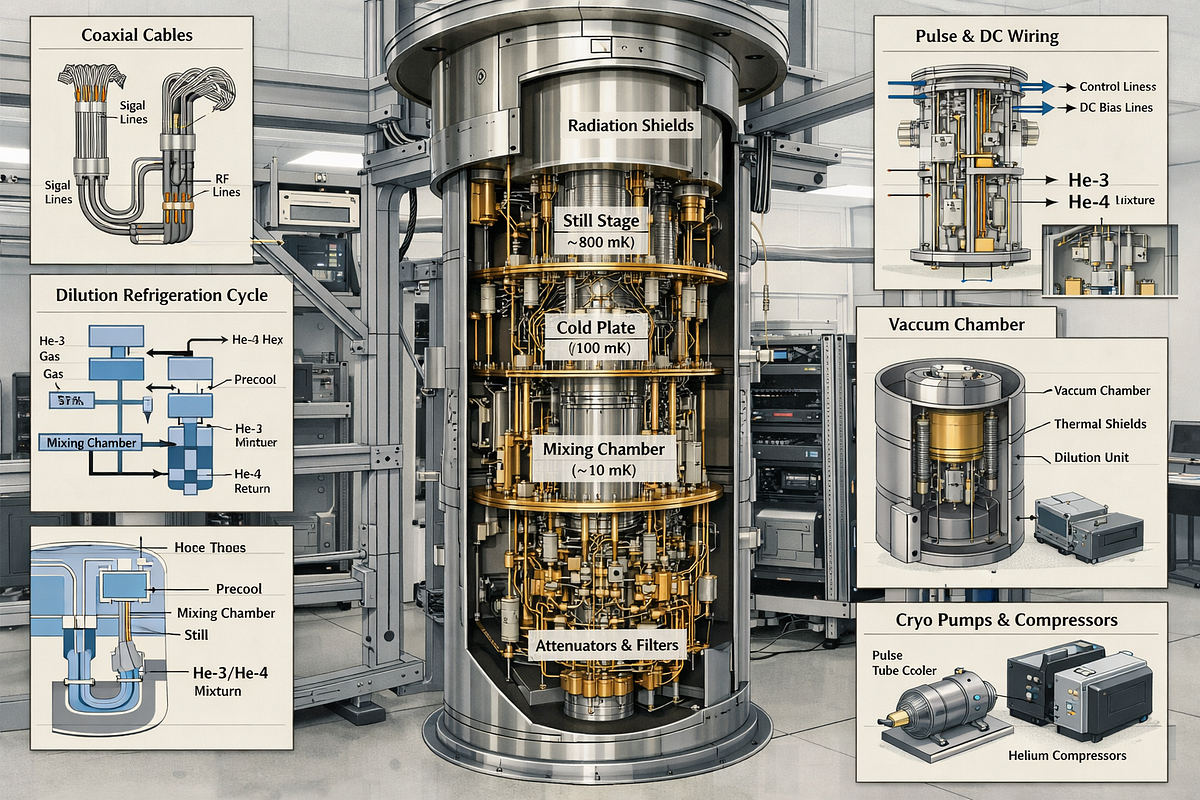
In both cases, the infrastructure is large, expensive, and operationally intensive. This reality has direct implications for deployment models: most quantum computers today are accessed via the cloud, not by convenience, but by necessity.
Calibration: Quantum Systems Drift Constantly
Unlike classical processors, quantum hardware does not remain stable over long periods. Qubit frequencies shift, control parameters drift, and environmental noise fluctuates. As a result, calibration is a continuous process rather than a one-time setup.
Modern systems may require:
- Multiple calibration cycles per day
- Automated routines to tune gate parameters
- Continuous benchmarking to monitor system health
These calibration requirements explain why uptime for quantum hardware looks very different from classical cloud infrastructure. Scheduled downtime is not a failure mode — it is part of normal operation.
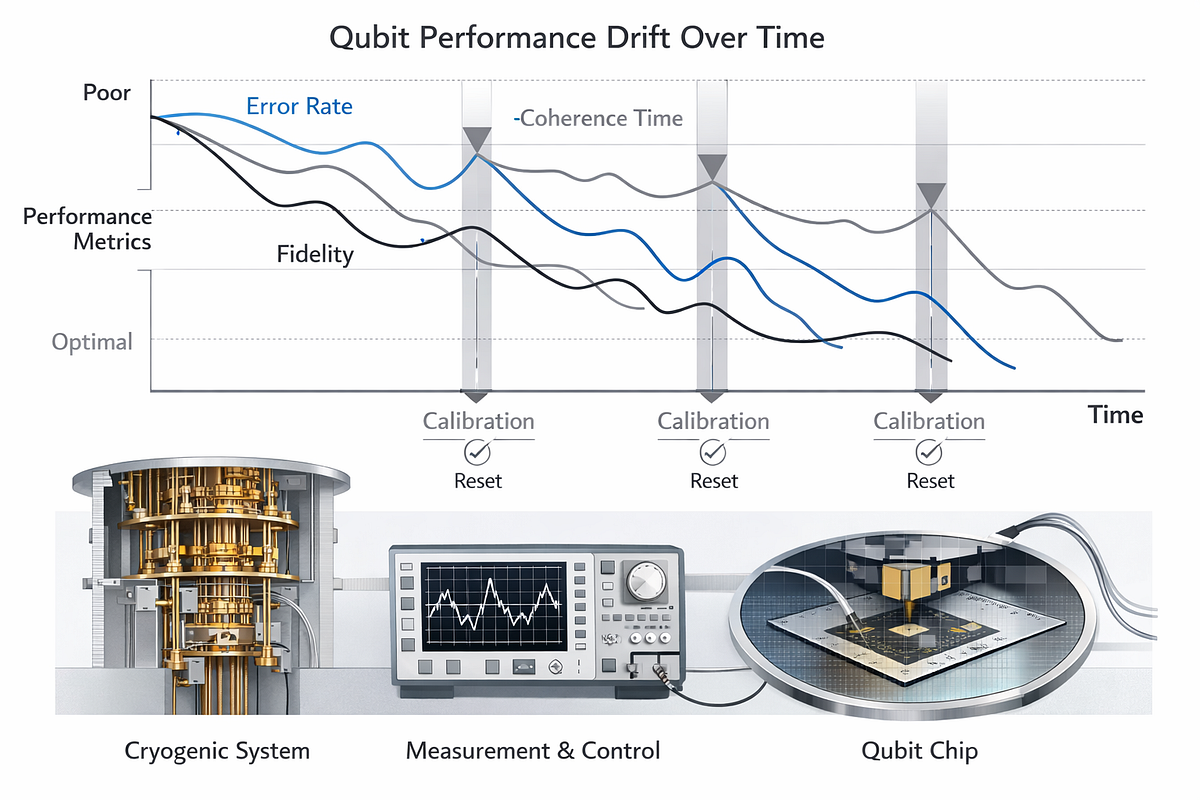
For users, this means performance can vary over time, and experimental results are often tied closely to the system’s calibration state at execution time.
Error Mitigation vs Error Correction: A Crucial Distinction
Popular discussions often imply that quantum computers will soon be “error corrected” in the same way classical computers are. In reality, most current systems rely on error mitigation, not full fault-tolerant error correction.
Error mitigation techniques attempt to reduce the impact of noise statistically — by extrapolating to zero noise, symmetrizing errors, or post-processing results — without encoding logical qubits across many physical ones. These methods can improve result quality for small circuits, but they do not scale indefinitely.
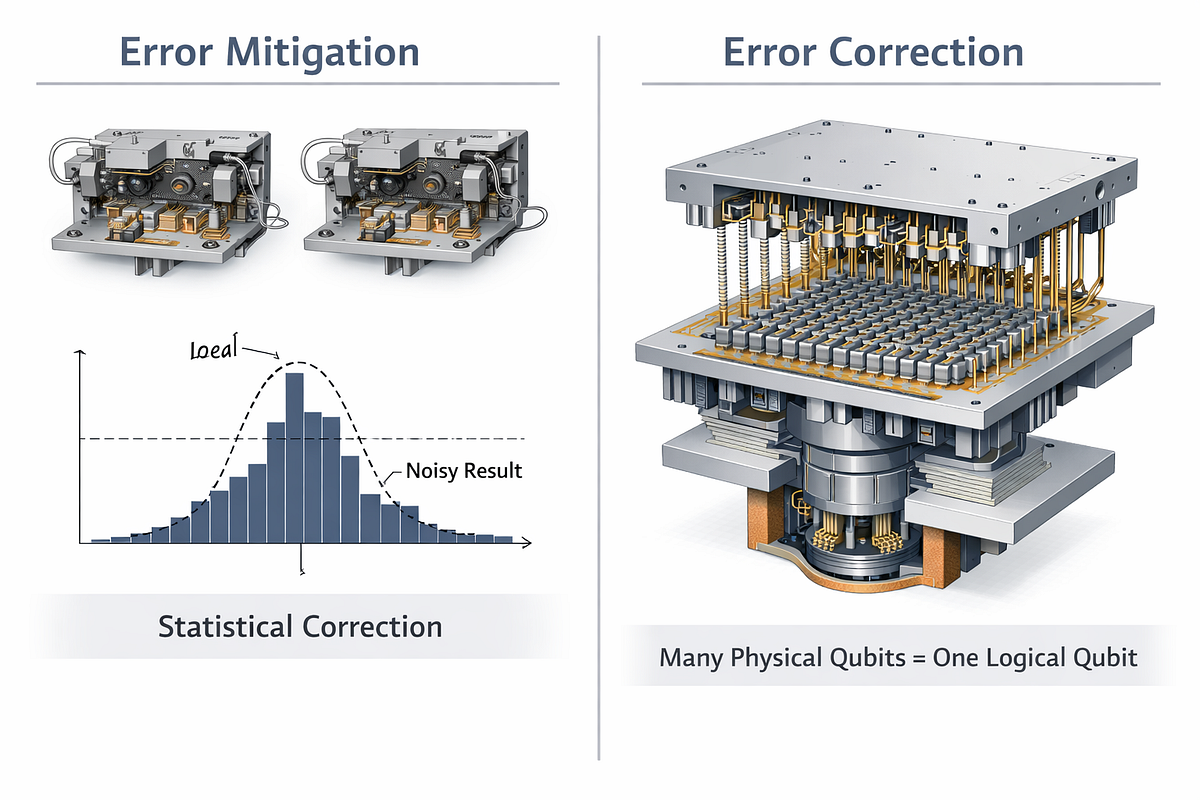
Full fault-tolerant quantum computing, by contrast, requires encoding each logical qubit into hundreds or thousands of physical qubits, along with substantial classical overhead. From a systems perspective, this remains a long-term goal rather than an imminent capability.
Understanding this distinction is essential for evaluating claims about near-term quantum advantage.
The Software Stack: Where Quantum Meets Classical
A quantum program does not run directly on hardware. Instead, it passes through multiple software layers:
- High-level frameworks define circuits or algorithms
- Compilers map abstract gates to hardware-native operations
- Optimizers reduce circuit depth and adapt to connectivity constraints
- Schedulers align execution with calibration windows and hardware availability
- Runtime systems manage execution, data collection, and error mitigation
In many cases, compilation and optimization on classical hardware take longer than the quantum execution itself. Queueing delays and scheduling constraints further shape user experience, particularly on shared cloud platforms.
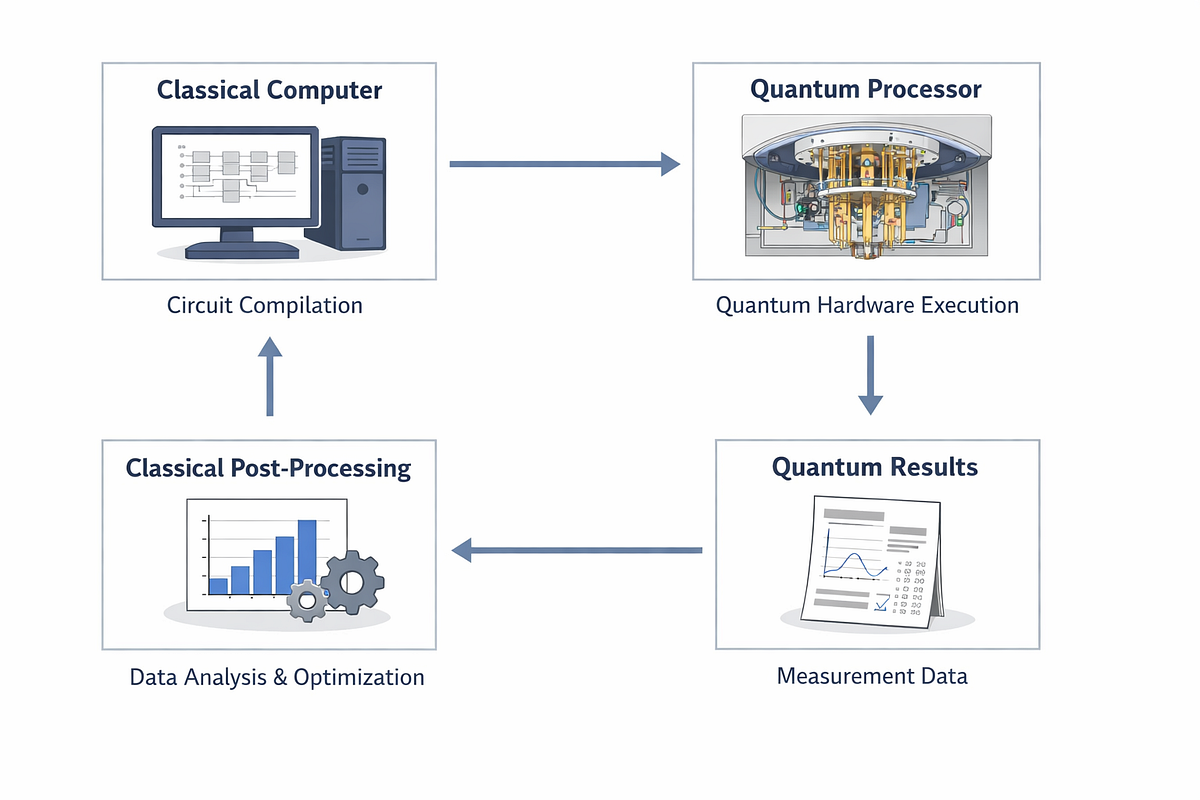
This reinforces a key system-level insight: quantum computing today is inseparable from classical computing. The two form a tightly coupled workflow rather than competing paradigms.
Modality Trade-Offs: No Universal Architecture
From a systems engineering standpoint, no single qubit modality is clearly dominant across all dimensions. Each reflects a different set of trade-offs:
- Superconducting systems emphasize fast gates and industrial scalability, at the cost of coherence and cryogenic complexity
- Trapped-ion systems prioritize fidelity and connectivity, trading off speed and optical complexity
- Photonic and neutral-atom platforms explore alternative scaling paths, with promising but still emerging system-level maturity
The diversity of approaches is not a weakness of the field; it is a rational response to unresolved scaling challenges. For practitioners and decision-makers, this means architectural pluralism is likely to persist for the foreseeable future.
Operational Lessons from Real Systems
Several lessons consistently emerge when working with real quantum platforms:
- Hardware limits dominate algorithm performance. Clever algorithms cannot overcome poor fidelity or limited connectivity.
- Small instabilities matter. Minor calibration drift can significantly affect outcomes.
- Classical bottlenecks are real. Compilation, scheduling, and data movement often overshadow quantum runtime.
- Cloud access shapes usage patterns. Queueing and availability influence experimentation more than raw qubit count.

These realities explain why many early quantum benchmarks behave unpredictably and why reproducibility remains a challenge.
What This Means for the Near Term
From a systems-focused perspective, quantum computing today is neither a failure nor a panacea. It is a technically impressive but operationally constrained platform best suited for experimentation, benchmarking, and niche workloads.
The most productive near-term strategies emphasize:
- Noise-aware algorithms and hybrid workflows
- Cloud-based experimentation over bespoke infrastructure
- Modality diversification rather than single-path bets
- System-level metrics instead of headline qubit counts
Fault-tolerant, general-purpose quantum computing remains a long-term objective, likely measured in decades rather than years. The path forward is incremental, engineering-driven, and heavily dependent on improvements across the entire system stack.
Closing Perspective
Quantum computing is often framed as a battle between theory and hardware, or as a race toward qubit milestones. In practice, it is a systems engineering challenge of unusual complexity — one where fragile quantum components depend on robust classical infrastructure, careful calibration, and disciplined operational workflows.
Understanding how these systems actually work does not diminish their promise. It clarifies it. For engineers, executives, and policymakers alike, realistic mental models are the foundation for sound decisions, credible roadmaps, and meaningful progress.
Those who approach quantum computing as an integrated system — rather than a single breakthrough technology — will be best positioned to extract value as the field continues to mature.


Comments
Post a Comment