Quantum Computing System Architecture: Why Qubits Alone Don’t Scale
For more than a decade, the quantum computing industry has measured progress primarily in qubits. Roadmaps, press releases, and conference keynotes routinely highlight qubit counts, fidelity improvements, and hardware breakthroughs. Yet when you look closely at how real quantum systems behave outside of controlled demonstrations, a different reality emerges.
Quantum computing is not primarily a qubit problem.
It is a system architecture problem.
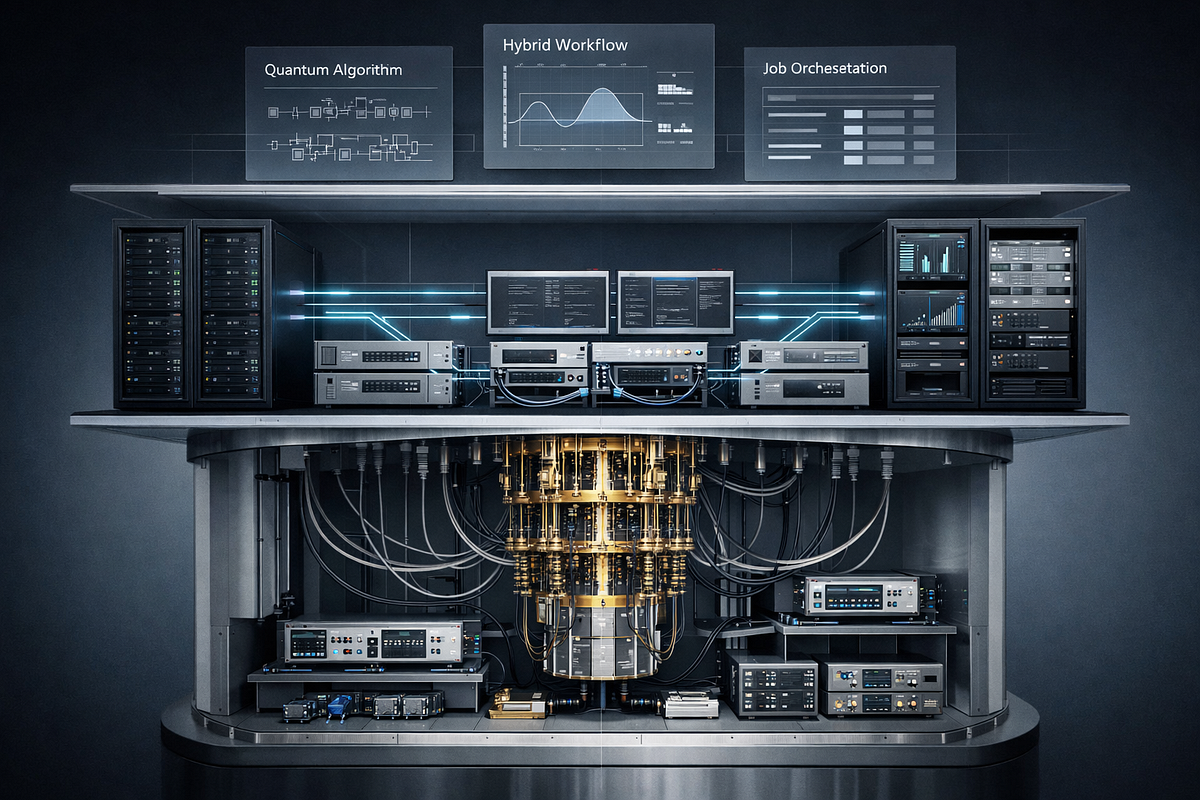
From control electronics and calibration pipelines to runtimes, orchestration layers, and classical–quantum feedback loops, the architecture surrounding the qubits increasingly determines whether a system can execute useful workloads at all. This is especially true in the NISQ era, where imperfect hardware places extraordinary demands on the rest of the stack.
This article examines the architecture of quantum computing systems from an end-to-end, practical perspective: how real systems are built, why many scale poorly, and what architectural choices actually matter today.
The Most Common Misconception: Scaling Equals More Qubits
One of the most persistent misunderstandings in quantum computing is the belief that scaling is primarily about adding qubits. In practice, increasing qubit count without proportionally scaling the rest of the system often makes a machine less usable.
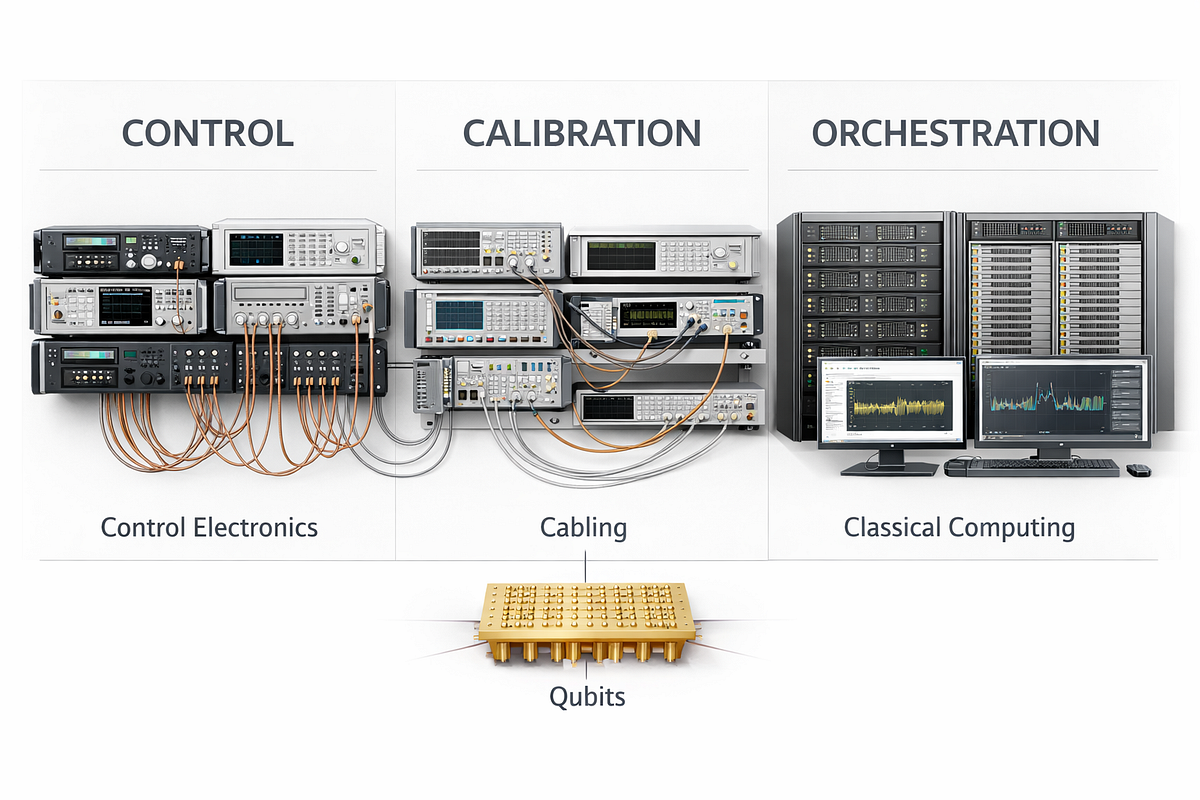
As systems grow from tens to hundreds of qubits, several non-obvious effects dominate:
- Control complexity grows faster than qubit count
Each qubit introduces additional control lines, timing constraints, pulse calibration, and readout paths. These scales superlinearly in many architectures. - Calibration time explodes
Calibration routines that complete in minutes on small systems can require hours on larger devices, dramatically reducing uptime and experiment throughput. - Crosstalk and interference increase
Denser wiring, shared electronics, and thermal load introduce instability that degrades effective fidelity even when individual qubits improve.
The architectural reality is that a well-integrated 50–100 qubit system can outperform a poorly orchestrated 200+ qubit system on real workloads. Headline qubit numbers obscure this fact.
Why “Cloud Access” Is Not the Same as System Readiness
Cloud access has been transformative for quantum research. It has democratized experimentation and accelerated software development. However, cloud availability is often mistaken for architectural maturity.
From a system perspective, cloud access hides — rather than solves — many critical bottlenecks:
- Latency between quantum execution and classical processing
- Limited visibility into control and calibration constraints
- Rigid scheduling models that waste valuable qubit time
- Restricted feedback loops that limit error mitigation
Cloud platforms are excellent R&D tools, but they do not guarantee that a system is architecturally ready for sustained, reliable computation. Readiness depends on whether the full stack — hardware, control, runtime, and orchestration — can support repeatable execution under real-world conditions.
Case Studies: Where Systems Break Before Qubits Do
1. Control and Calibration Bottlenecks at Scale
In one superconducting qubit platform, scaling from roughly 50 to 200 qubits exposed a fundamental architectural limit. While fabrication and basic qubit performance improved, the control and calibration infrastructure did not scale at the same rate.
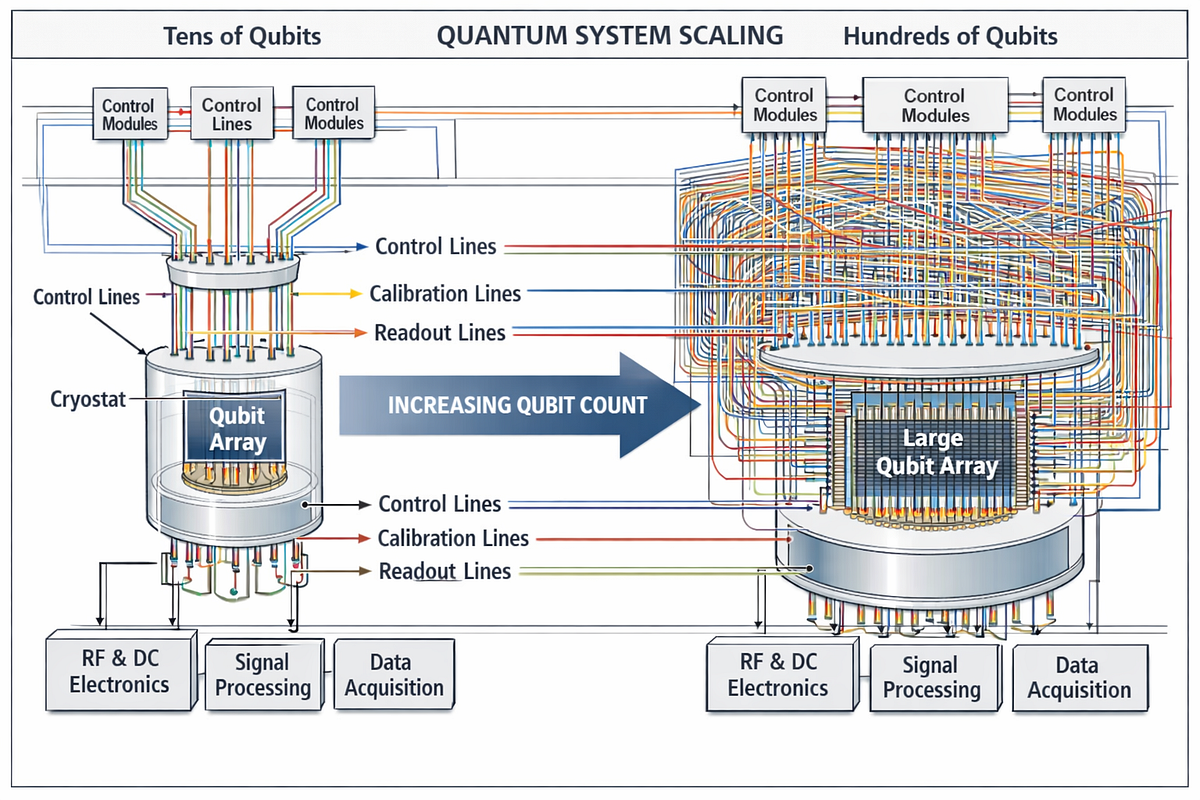
What changed at scale:
- Calibration routines expanded from minutes to hours
- Crosstalk and thermal effects destabilized gate performance
- System downtime increased dramatically
The lesson was clear: without scalable calibration pipelines and modular control electronics, adding qubits reduced overall system productivity.
2. Classical Infrastructure as the Performance Ceiling
In a trapped-ion system executing mid-depth circuits on 50–60 qubits, the limiting factor was not qubit fidelity or connectivity — it was the classical controller.
Specifically:
- Measurement processing latency prevented real-time feedback
- Hybrid workflows suffered from scheduling inefficiencies
- Qubits sat idle while classical orchestration caught up
This highlights a critical architectural truth: quantum computers are hybrid systems. Classical latency, scheduling, and feedback frequently dominate performance before quantum hardware limits are reached.
3. Early Design Choices That Failed at Scale
A system initially designed for 20–30 qubits used a sequential, shared control bus. At a small scale, this simplified calibration and control. At larger scale, it became a hard bottleneck.
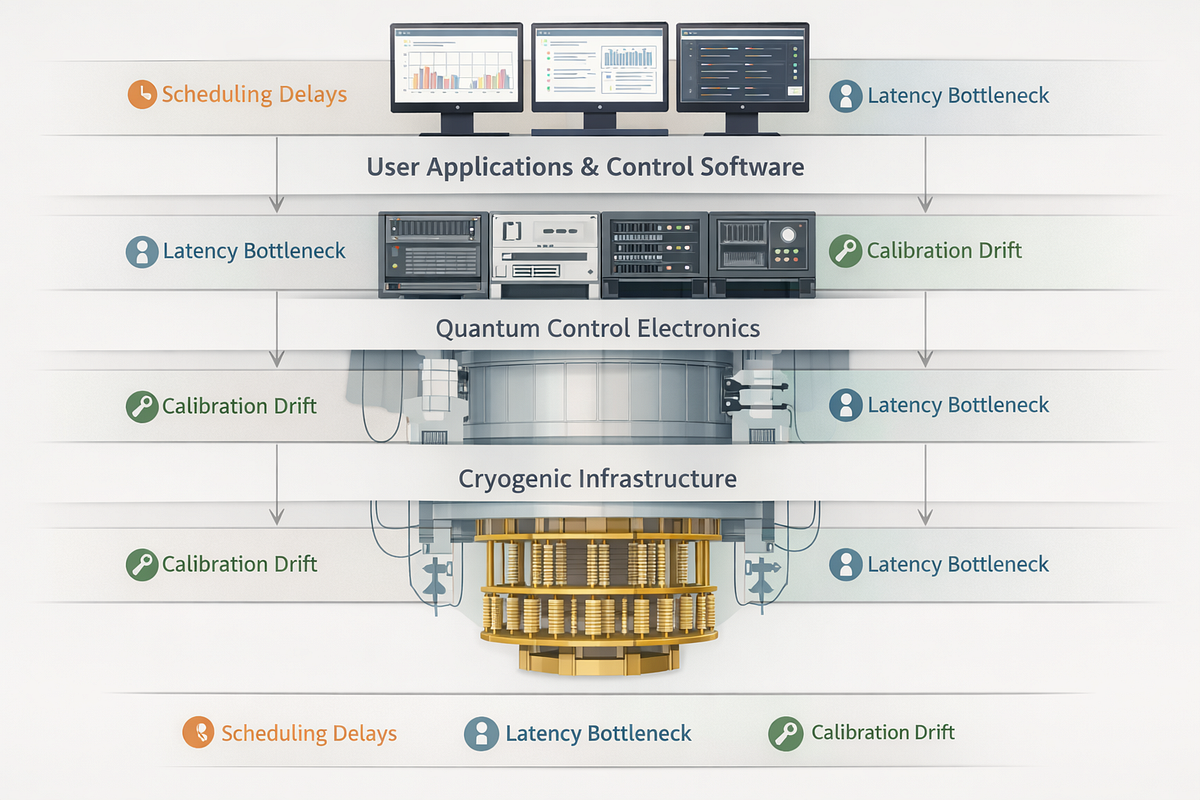
When scaling beyond 100 qubits:
- Sequential access limited throughput
- Timing conflicts increased error rates
- Parallelization required a full control redesign
Architectural shortcuts that work in prototypes often fail catastrophically at scale. Modular, parallelized control is not an optimization — it is a prerequisite for growth.
The Architectural Decision That Matters Most: Classical–Quantum Co-Design
Among all design choices, one stands out as consistently underestimated: classical–quantum co-design.
Near-term quantum performance is constrained less by qubit physics than by how tightly the quantum processor is integrated with classical compute, control, and orchestration layers.
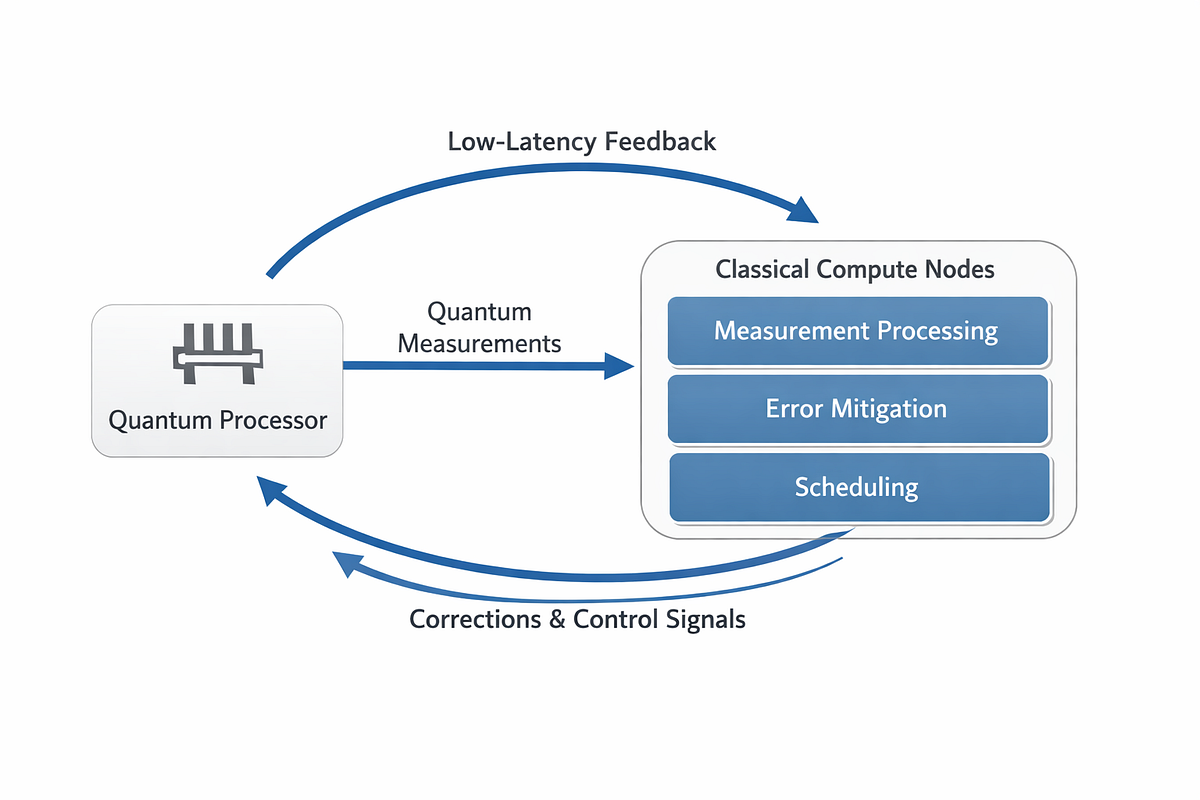
Why this matters:
- Latency defines feasible circuits.
Feedback delays turn theoretically valid circuits into architectural impossibilities. - Error mitigation depends on fast classical processing.
Calibration, post-processing, and adaptive execution all require tight feedback loops. - Fault tolerance is a system's problem.
Error correction demands deterministic timing, massive control bandwidth, and runtimes designed for continuous monitoring. - Hybrid workloads define real usage.
Quantum processors act as accelerators within larger HPC or cloud workflows, not standalone machines.
Historically, classical computing advanced through co-design — CPUs, memory, interconnects, and software evolved together. Quantum computing will follow the same path.
Overhyped Architectural Narratives — and Better Alternatives
Several popular narratives collapse under system-level scrutiny:
- “Better qubits automatically mean better systems.”
Reality: without scalable control and orchestration, qubit improvements deliver diminishing returns. - “Hardware-agnostic software stacks will solve portability.”
Reality: performance-critical systems require hardware-aware compilation and runtime behavior. - “Error correction can be added later.”
Reality: fault tolerance reshapes architecture from the ground up and cannot be retrofitted easily. - “One modality will dominate everything.”
Reality: superconducting, trapped-ion, annealing, photonic, and neutral-atom systems excel in different architectural roles.
A more accurate framing recognizes quantum computing as a heterogeneous, hybrid, full-stack engineering discipline.
A Practical Framework for Evaluating Quantum System Architecture
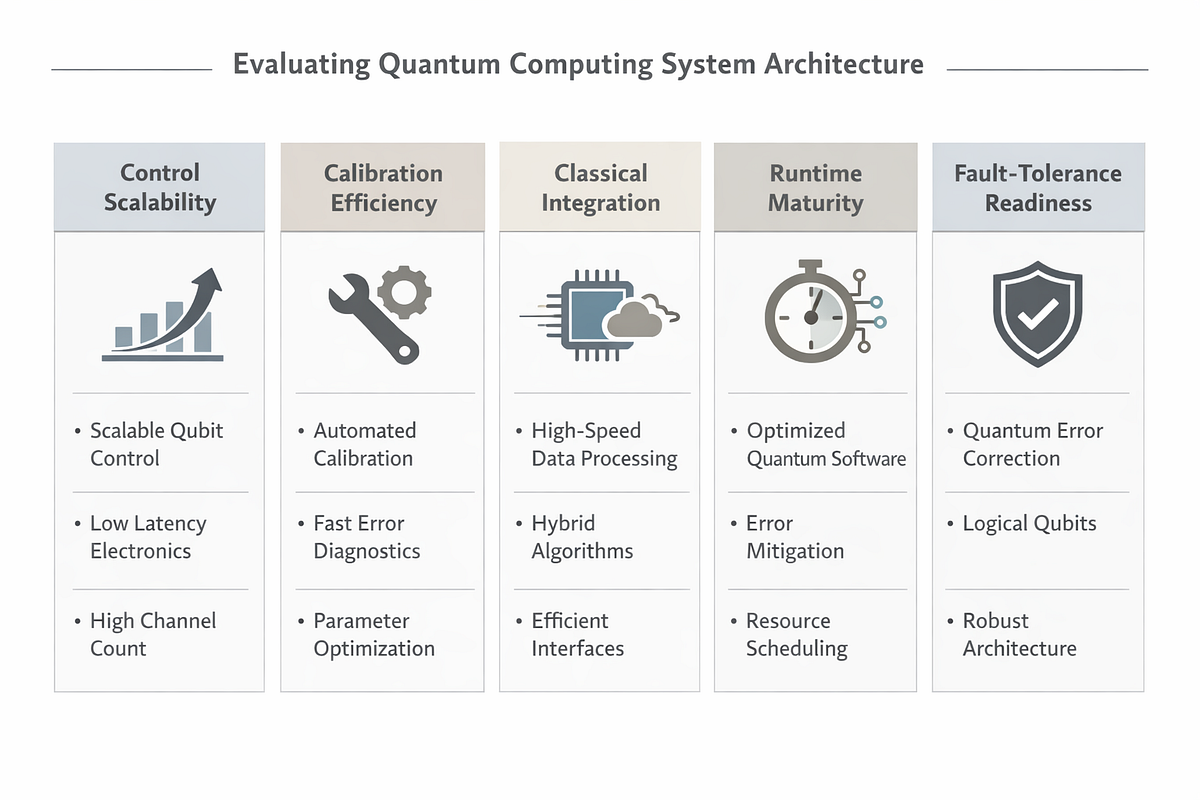
When evaluating a quantum platform — whether as a builder, buyer, or advisor — focus on the following questions:
- Control scalability
Do control electronics, timing, and signal routing scale proportionally with qubits? - Calibration efficiency
Does calibration overhead grow linearly, or does it dominate system uptime? - Classical integration
Are feedback loops, scheduling, and orchestration designed for hybrid workloads? - Runtime maturity
Can the system support adaptive execution, error mitigation, and evolving workflows? - Fault-tolerance readiness
Is the architecture compatible with future error correction requirements?
A simple heuristic captures this mindset:
For every qubit added, can the control, calibration, and classical infrastructure scale without becoming the bottleneck?
If the answer is unclear, the architecture will struggle long before qubits run out.
Conclusion: Architecture Determines Outcomes
Quantum computing will not succeed because a single system crosses a qubit threshold or achieves a headline “quantum advantage” milestone. Progress will be incremental, uneven, and driven by architecture more than physics.
In the NISQ era, the decisive factors are:
- Control and calibration scalability
- Classical–quantum co-design
- Robust orchestration and hybrid workflows
Organizations that understand this will build systems that improve steadily and deliver real value. Those that chase qubit counts without architectural discipline will continue to produce impressive demos — and disappointing results.
Quantum computing is not a race to more qubits.
It is a systems engineering challenge, end-to-end.


Comments
Post a Comment