Quantum Computing System Overview: A Full-Stack Perspective
Quantum computing is often discussed as a revolutionary leap driven by exotic physics and ever-increasing qubit counts. In practice, however, a quantum computer is not a single breakthrough device but a complex, tightly coupled system — one that blends fragile quantum hardware with sophisticated classical control, software stacks, and hybrid execution models.
This article provides a systems-level overview of quantum computing, written for a mixed technical audience that includes technology executives, system architects, senior engineers, and advanced learners. It assumes familiarity with classical computing architectures while introducing just enough quantum background to understand how real quantum systems are built, programmed, and operated today.

Rather than focusing on abstract algorithms or marketing milestones, the emphasis here is on how quantum computers actually function as end-to-end systems, where performance is often constrained less by physics alone and more by integration, orchestration, and software–hardware co-design.
Quantum Computers Are Systems, Not Devices
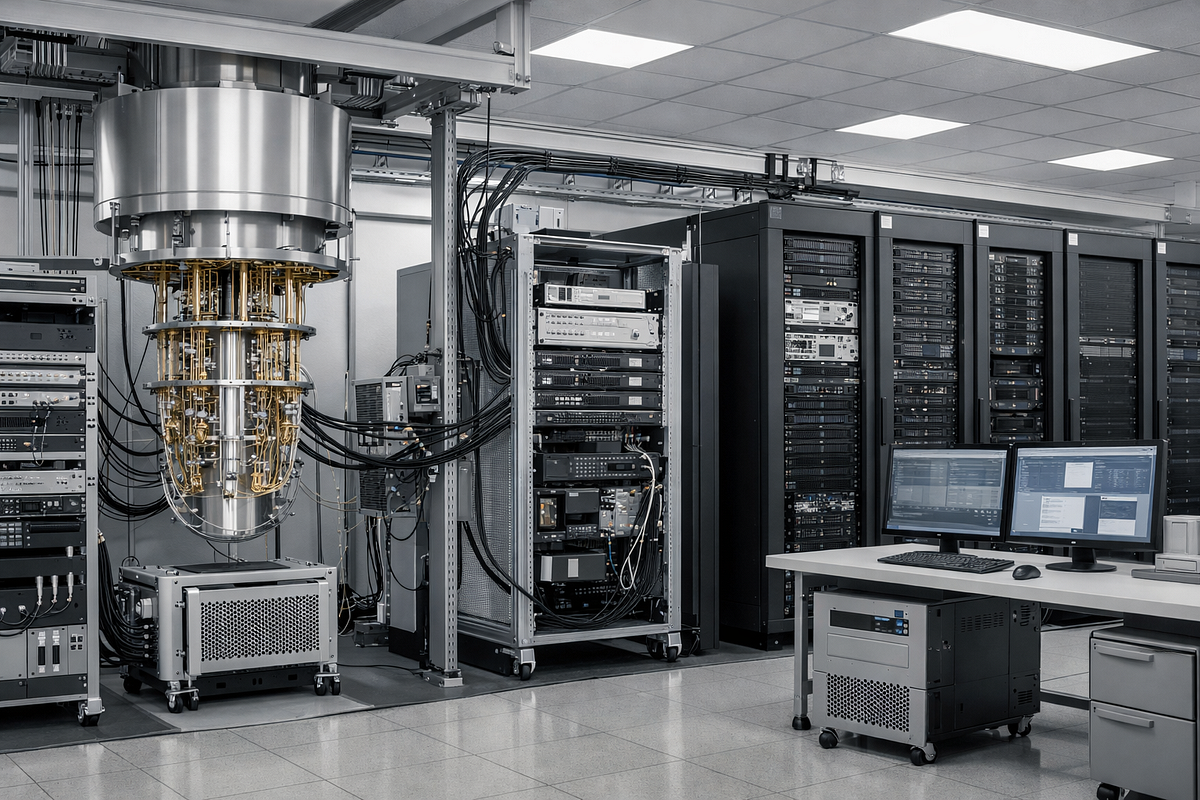
A useful starting point is to abandon the idea of a quantum computer as a monolithic machine. In reality, modern quantum platforms resemble heterogeneous computing systems, more akin to GPU-accelerated clusters than standalone CPUs.
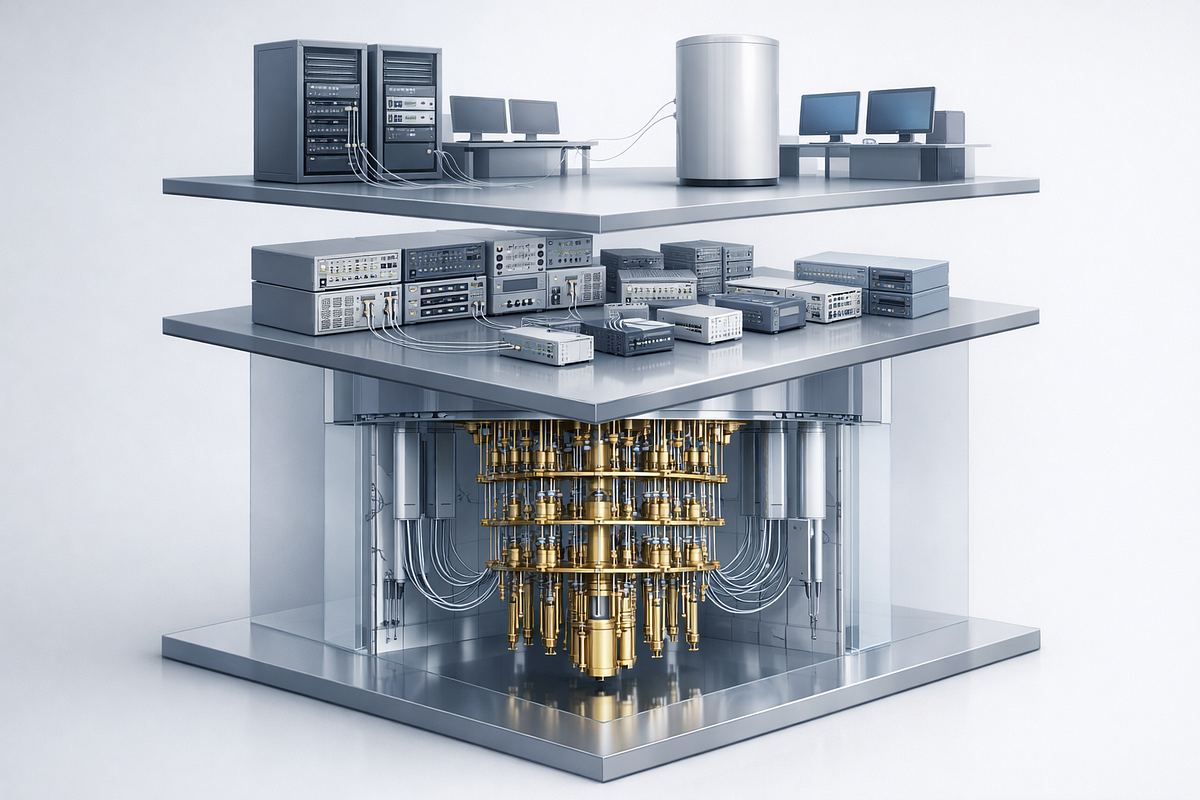
At a high level, a quantum computing system consists of:
- A quantum processing unit (QPU) based on physical qubits
- Extensive control electronics and infrastructure, often including cryogenic environments
- A layered quantum software stack, from compilers to SDKs
- Classical compute resources are tightly integrated for control, feedback, and orchestration
Crucially, most quantum workloads today execute in a hybrid classical–quantum loop, where classical processors prepare inputs, invoke quantum circuits, analyze outputs, and iteratively refine execution. Treating the QPU in isolation misses where much of the real complexity — and opportunity — lies.
A Brief Quantum Primer (Without the Physics Detour)
For readers grounded in classical systems, a minimal conceptual bridge is sufficient.
- Qubits are the quantum analogue of bits, capable of existing in superpositions of 0 and 1.
- Entanglement enables correlated qubit states that cannot be described independently of each other.
- Measurement collapses quantum states into classical outcomes, introducing probabilistic behavior.
What matters at the system level is not the mathematical formalism, but the operational consequence: quantum states are fragile, noisy, and expensive to control. This fragility shapes every layer of the system stack.
Hardware Layer: Qubits Are Necessary, but Not Sufficient
Much public attention focuses on qubit technologies — superconducting circuits, trapped ions, photonics, and annealing-based systems. Each comes with distinct trade-offs in coherence times, gate speeds, connectivity, and scaling potential.
From a systems perspective, the critical point is this:
Raw qubit count is a poor proxy for system capability.
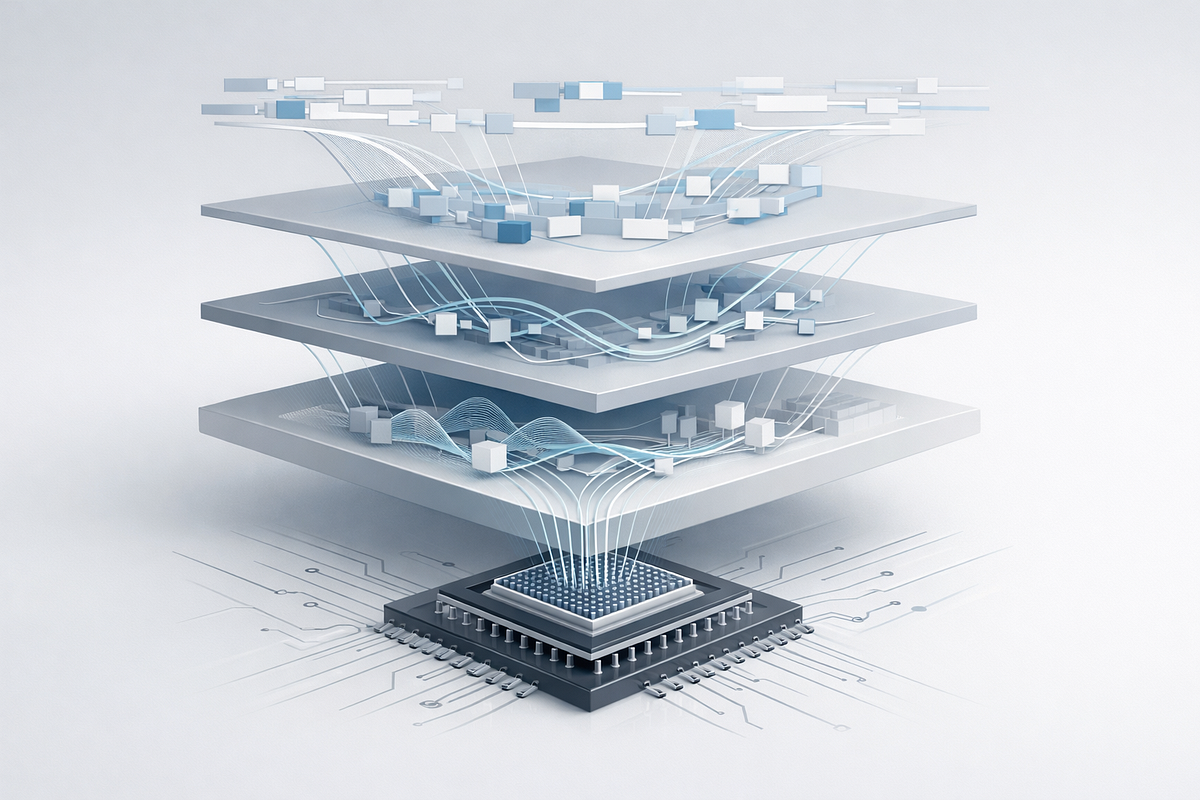
Usable performance depends on factors such as:
- Error rates and gate fidelity
- Qubit connectivity and topology
- Crosstalk and calibration overhead
- Control latency and stability
In several real-world cases, systems with fewer, higher-quality qubits have outperformed larger but noisier devices when running practical workloads. Scaling without addressing these constraints often leads to diminishing returns.
Control Electronics and Infrastructure: The Hidden Backbone
One of the least discussed — but most consequential — components of quantum systems is the control layer.
Quantum processors require:
- High-precision microwave or laser control
- Continuous calibration and tuning
- Low-latency classical feedback
- In many cases, cryogenic environments operating at millikelvin temperatures
As systems scale, control electronics and thermal management become dominant engineering challenges. Latency, wiring complexity, and signal integrity can limit performance long before qubit physics does.
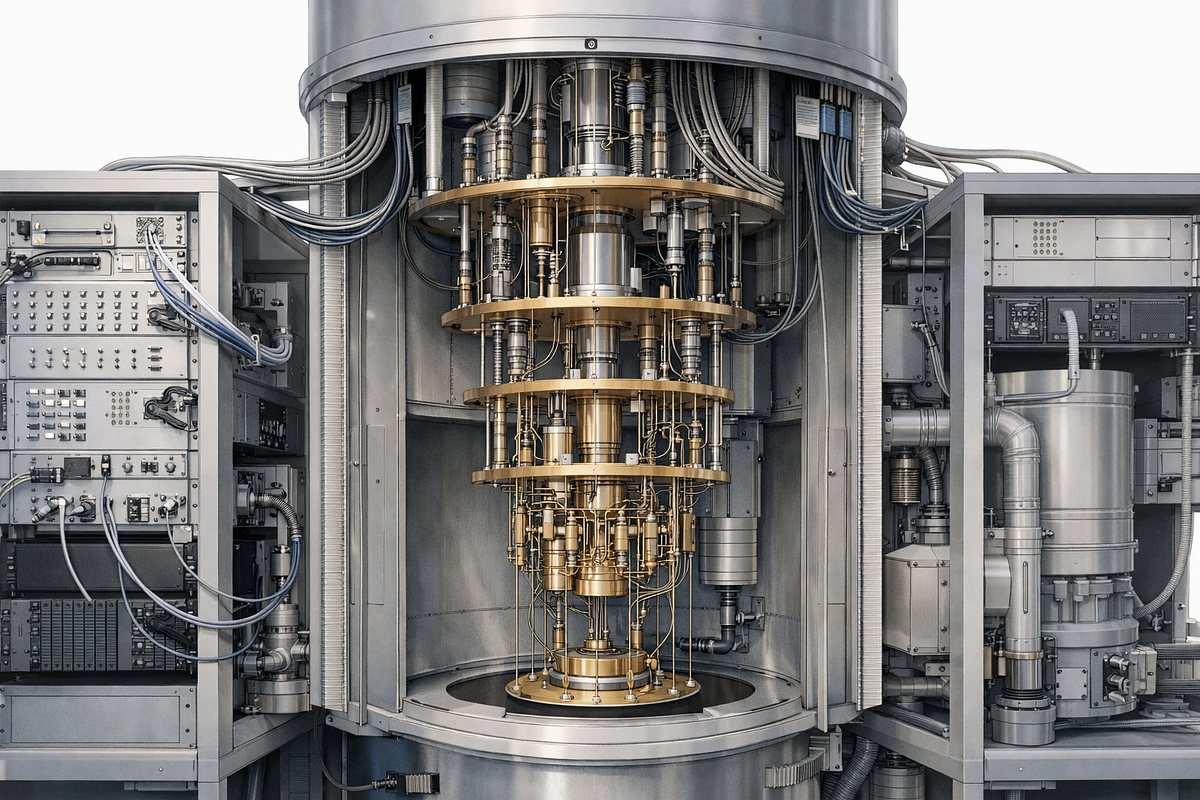
From an architectural standpoint, this is why modularity, automation, and control–software integration are central to any credible scaling roadmap.
The Quantum Software Stack: Where Most Progress Happens
While hardware garners headlines, the quantum software stack is where much of the near-term differentiation occurs.
A typical stack includes:
- Firmware and pulse-level control
- Compilers that map logical circuits to physical qubits
- Runtime systems that manage execution and scheduling
- SDKs and APIs used by developers
In practice, performance is often dominated by how well software understands hardware constraints. Noise-aware compilation, topology-aware mapping, and calibration-informed scheduling can significantly improve results without changing the underlying qubits.
In my experience analyzing quantum systems, full-stack optimization frequently matters more than incremental hardware improvements, particularly in the NISQ (Noisy Intermediate-Scale Quantum) era.
Hybrid Classical–Quantum Orchestration: The Real Execution Model
One of the most persistent misconceptions is that quantum computers operate as standalone machines. In reality, almost all meaningful workloads today rely on tight classical–quantum integration.

Hybrid algorithms such as variational quantum eigensolvers (VQE) and optimization routines depend on:
- Classical pre-processing and parameter selection
- Iterative quantum circuit execution
- Classical post-processing and convergence analysis
This feedback-driven execution model places stringent demands on orchestration, latency, and system reliability. Organizations that explicitly design for hybrid workflows — rather than treating them as an afterthought — are consistently better positioned to extract value from current hardware.
Quantum Error Correction: A System Constraint, Not a Feature
Fault tolerance is often framed as a future milestone, but its implications are already shaping the design of systems.
Error correction requires:
- Large numbers of physical qubits per logical qubit
- Continuous syndrome measurement and classical processing
- Deep integration between hardware, firmware, and software
Even partial fault tolerance introduces substantial classical overhead. As a result, error correction should be viewed less as a discrete upgrade and more as a cross-cutting system constraint that influences architecture, control, and software design choices today.
Real-World Lessons from Quantum Systems
Several anonymized examples illustrate how system-level factors dominate outcomes:
- Exceeding expectations: Early superconducting systems running small-scale chemistry simulations achieved better-than-expected accuracy when noise-aware compilation and hybrid orchestration were carefully tuned.
- Falling short: Some high-qubit-count devices with excellent coherence failed to deliver algorithmic performance due to connectivity limitations and control latency.
- Integration bottlenecks: In cloud-based environments, compiler inefficiencies and orchestration latency — not qubit quality — often delay or limit usable results.
The common thread is clear: success or failure is rarely determined by a single layer.
Common Myths That Distort Decision-Making
Several oversimplifications continue to skew expectations:
- Quantum computers are not faster versions of classical machines.
- Qubit count alone does not determine capability.
- Algorithms do not matter more than systems engineering — at least not yet.
- Scaling is not solved by “just adding more qubits.”
- Quantum advantage will be incremental and domain-specific, not universal or sudden.
Correcting these myths is essential for realistic roadmapping and investment decisions.
Where Quantum Computing Stands Today
From a systems perspective, quantum computing is at an inflection point.
Hardware, control systems, and software stacks are improving in tandem. Early, niche applications are demonstrating measurable value, particularly in chemistry, optimization, and hybrid workflows. At the same time, large-scale, fault-tolerant systems remain a work in progress.
This is neither a hype bubble nor a finished technology — it is a transitional phase where disciplined systems engineering matters more than bold claims.
The Next 5–10 Years: What Will Actually Matter
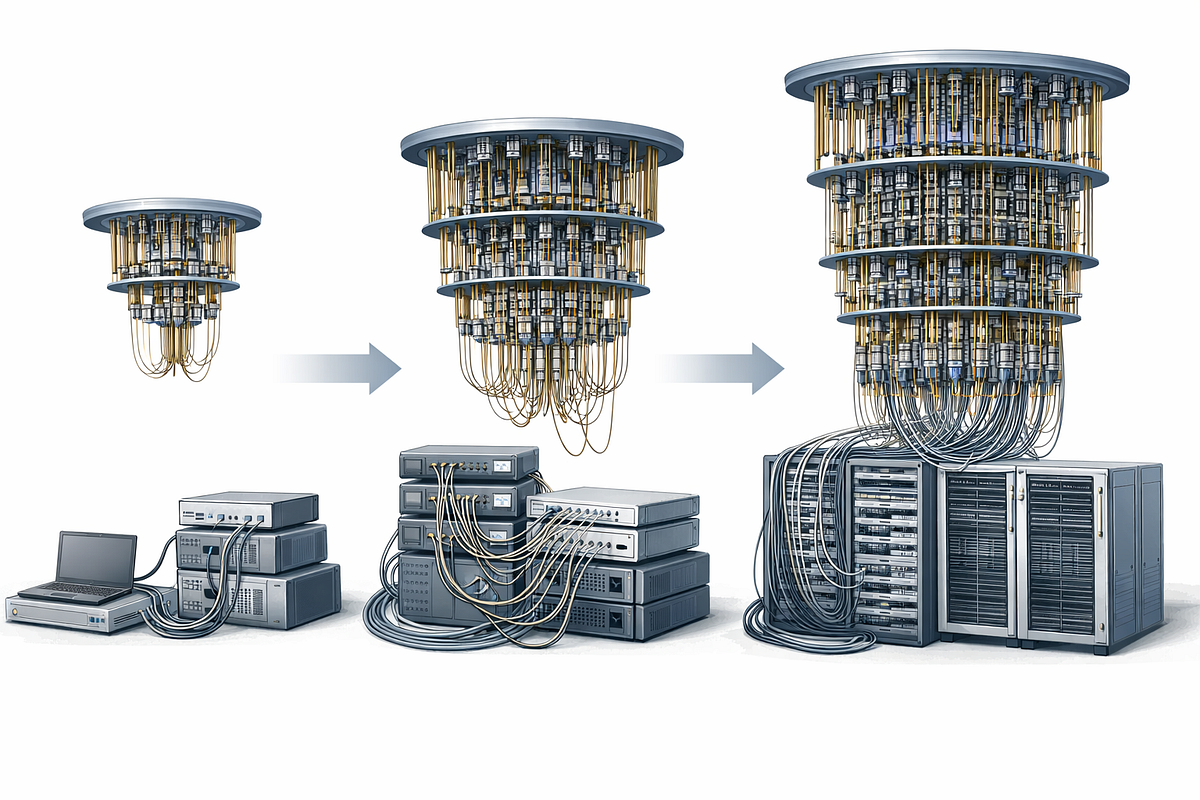
The most important breakthroughs ahead are unlikely to be single headline achievements. Instead, progress will hinge on:
- Modular and scalable system architectures
- Practical, hardware-aware error correction
- Full-stack co-design across hardware, controls, and software
- Sophisticated hybrid classical–quantum orchestration
- Automation in calibration, compilation, and execution
Organizations that treat quantum computing as an end-to-end systems problem — rather than a physics experiment or algorithm race — will be best positioned to succeed.
Final Thoughts: Think Like a Systems Engineer
Quantum computing’s future will not be determined by qubits alone. It will be shaped by how effectively we integrate fragile quantum devices into robust, scalable, and programmable systems.
For executives, architects, and engineers alike, the key takeaway is this:
Quantum advantage is a systems outcome, not a hardware feature.
Understanding that distinction is essential — not only for building better machines, but for making better decisions about where and how quantum computing can deliver real value.


Comments
Post a Comment