Quantum Computing Systems for Advanced Problem Solving
Why Hybrid Architectures — not Standalone Quantum Machines — Will Define Real-World Impact
Quantum computing is no longer constrained by a lack of theoretical promise. The field has demonstrated compelling algorithms, diverse hardware modalities, and undeniable scientific progress. What remains unresolved — and frequently misunderstood — is how quantum computing becomes operationally useful for real problem solving.
After more than a decade of sustained engagement with quantum technologies — spanning algorithms, hardware constraints, error correction, benchmarking, and system integration — I have become increasingly convinced of a simple but uncomfortable truth:
Hybrid quantum–classical systems are not a temporary bridge to “pure” quantum computing. They are the only realistic path to meaningful quantum advantage in the foreseeable future.

Organizations that continue to evaluate quantum computers as standalone machines — isolated from classical infrastructure, software stacks, and enterprise workflows — are setting themselves up for disappointment. Those who treat quantum computing as a system engineering problem, embedded within heterogeneous computing environments, are the ones most likely to extract real value.
This article is written for CTOs, system architects, advanced practitioners, and decision-makers who care less about qubit headlines and more about when — and how — quantum computing becomes practically useful.
Moving Beyond the Qubit Race
Public narratives around quantum computing remain dominated by simplified metrics: qubit counts, coherence times, and isolated demonstrations of “quantum supremacy.” These milestones matter scientifically, but they are poor predictors of real-world problem-solving capability.
From a systems perspective, what matters is not how many qubits exist on a chip, but how many effective qubits can be reliably orchestrated within a usable computational depth, under realistic noise, control, and integration constraints.
In practice, system performance is shaped by factors that rarely make headlines:
- Gate fidelity and correlated error behavior
- Connectivity and routing overhead
- Control electronics and calibration stability
- Latency between quantum execution and classical feedback
- Compiler efficiency and scheduling intelligence
- Error mitigation effectiveness under real workloads
A system with fewer, high-fidelity, well-integrated qubits routinely outperforms a larger but poorly controlled device when embedded in a hybrid workflow. This reality cuts across hardware paradigms — superconducting qubits, trapped ions, neutral atoms, and beyond.
The lesson is clear: quantum advantage is a system-level property, not a hardware statistic.
Why Standalone Quantum Computers Fail in Practice
The idea that quantum computers will eventually replace classical machines mirrors early misconceptions about GPUs, accelerators, and even cloud computing. In every case, the breakthrough came not from replacement, but from integration.

Treating quantum processors as independent compute engines fails for several reasons:
- Problem decomposition remains classical.
Mapping real-world problems — molecular systems, optimization constraints, or material properties — into quantum-executable forms requires substantial classical preprocessing. - Feedback loops are unavoidable.
Near-term quantum algorithms depend on iterative classical optimization, measurement analysis, and parameter tuning. Without tight orchestration, performance collapses. - Error mitigation is inherently hybrid.
Noise characterization, mitigation strategies, and validation all rely on classical control, modeling, and statistical analysis. - Economic viability demands selectivity.
Quantum execution is expensive and scarce. Only carefully selected subroutines justify offloading from classical compute.
When quantum systems are evaluated in isolation, they appear fragile, limited, and underwhelming. When embedded properly, they begin to look like what they actually are: specialized accelerators within heterogeneous computing stacks.
Hybrid Quantum–Classical Systems: The Real Architecture
The most productive way to think about quantum computing today — and likely for decades — is as part of a hybrid architecture that spans:
- Classical HPC or cloud infrastructure
- Quantum hardware accessed locally or via cloud services
- Control electronics and real-time feedback systems
- Compilers, schedulers, and orchestration layers
- Domain-specific application pipelines
In this model, quantum processors are invoked selectively, much like GPUs or FPGAs, to perform narrowly defined tasks where they can provide unique computational leverage.
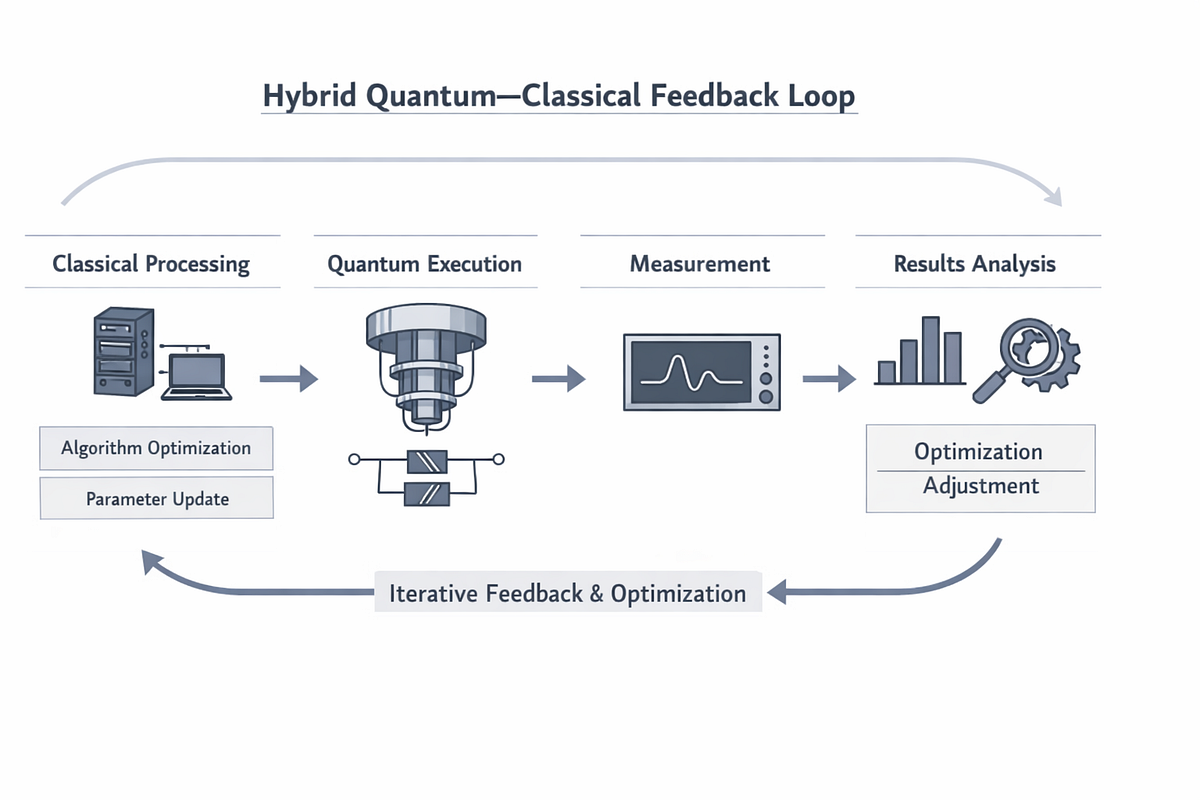
Crucially, this is not a stopgap measure while waiting for fault-tolerant machines. It is a durable architectural pattern.
Even fully error-corrected quantum computers will remain:
- Resource-intensive
- Application-specific
- Dependent on classical coordination
Expecting a clean transition from classical to “pure quantum” computing misunderstands both physics and systems engineering.
Hardware Modalities as System Trade-Offs, Not Winners
Debates over which qubit technology will “win” are largely unproductive. From a deployment standpoint, different hardware modalities represent different system trade-offs — not universal solutions.
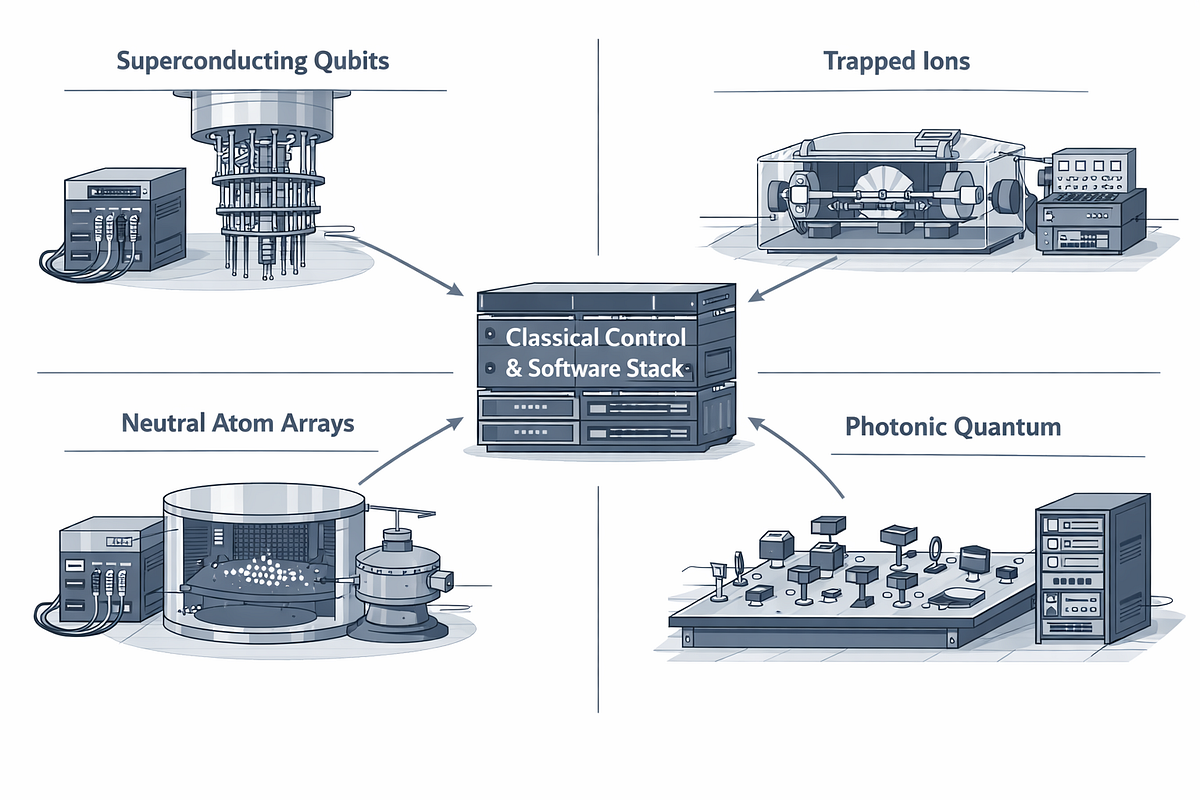
- Superconducting qubits offer fast gate times and mature tooling but impose significant cryogenic and wiring complexity.
- Trapped ions deliver high gate fidelity and connectivity at the cost of slower operations and scaling challenges.
- Neutral atoms show promise for scalability and structured analog-digital hybrids, but remain early in their system maturity.
- Photonic systems excel in networking and interconnects, potentially enabling distributed architectures rather than monolithic machines.
- Quantum annealers occupy a specialized niche in optimization, useful for certain problem classes but not representative of general-purpose quantum computing.
From a systems perspective, heterogeneity is not a weakness — it is an inevitability. The future quantum ecosystem will resemble today’s classical landscape: multiple architectures, accelerators, and interconnects, each optimized for different workloads.
Where Advanced Problem Solving Actually Makes Sense
Despite the hype, there are domains where quantum systems already demonstrate meaningful promise — provided expectations are calibrated correctly.
Materials Science and Chemistry
This remains the strongest near- to mid-term application area.
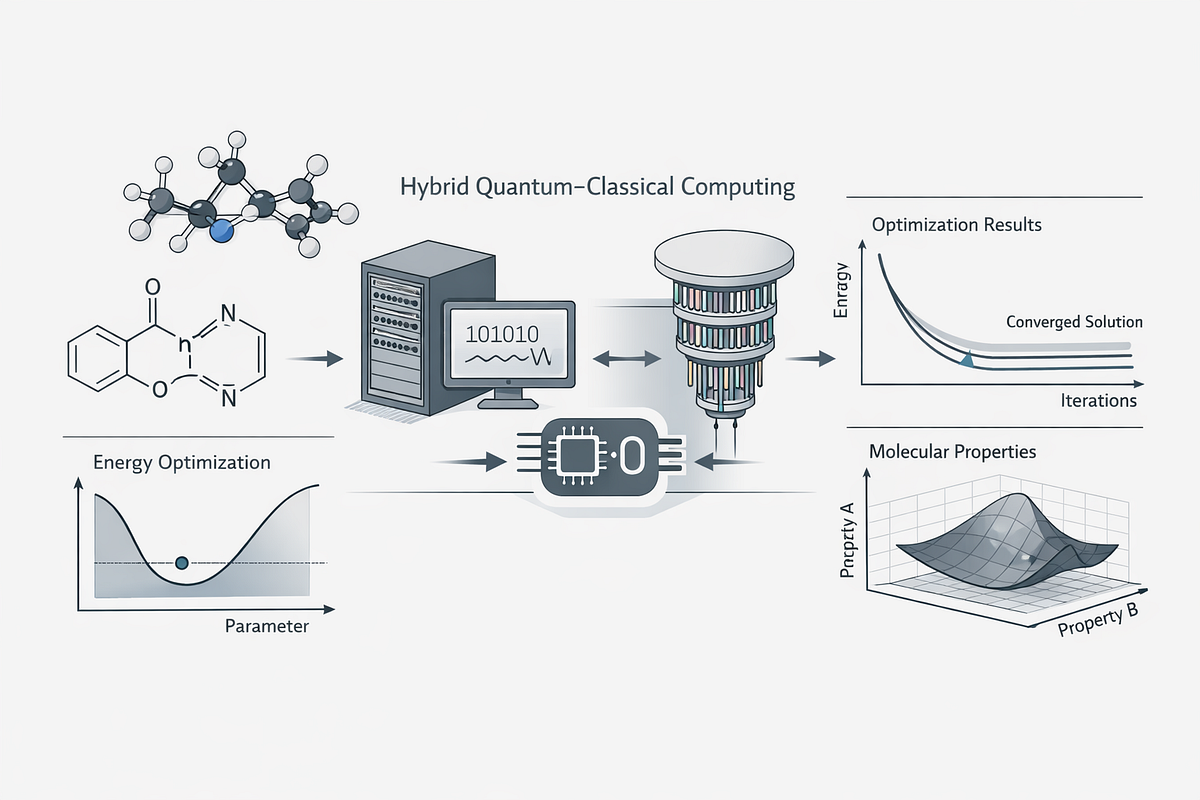
Hybrid algorithms such as the Variational Quantum Eigensolver have already shown value in simulating small molecules and simplified material models. While these systems do not yet replace classical chemistry pipelines, they can:
- Provide more accurate energy estimates for challenging configurations
- Guide classical simulations toward promising regions of parameter space
- Inform experimental design in catalysis and materials discovery
In practice, even modest improvements in simulation fidelity can translate into significant downstream R&D acceleration.
Structured Optimization
Optimization problems in logistics, finance, and energy often map well to hybrid quantum-classical approaches — particularly when constrained and decomposed carefully.
In controlled pilots, small quantum systems or annealers have demonstrated the ability to identify near-optimal solutions for limited instances, which then inform larger classical solvers. The value lies not in wholesale replacement, but in augmenting classical heuristics.
Scientific Simulation and Benchmarking
Quantum devices are increasingly useful as experimental platforms for studying error behavior, control strategies, and system-level performance. These insights feed directly into scaling strategies and software design, even when algorithmic advantage remains modest.
Where Caution Is Warranted
Machine learning and cryptography attract outsized attention, but near-term advantage remains narrow. Hybrid quantum ML models are interesting research tools, not production-ready disruptors. Cryptographic impact, while strategically important, belongs largely to long-term planning rather than immediate deployment.
Lessons from the Field: What Actually Happens in Practice
Across multiple pilots, proofs-of-concept, and feasibility studies — often conducted under strict confidentiality — several consistent patterns emerge.
What Works Better Than Expected
- Hybrid workflows deliver real insight.
Even noisy quantum circuits, when orchestrated properly, can produce useful signals that accelerate classical computation. - Error mitigation pays dividends.
Targeted mitigation strategies frequently extend effective circuit depth beyond pessimistic theoretical estimates. - Small experiments scale learning.
Carefully chosen toy problems often yield disproportionate value by clarifying system constraints and roadmap priorities.
Where Efforts Stall
- Scalability bottlenecks appear early.
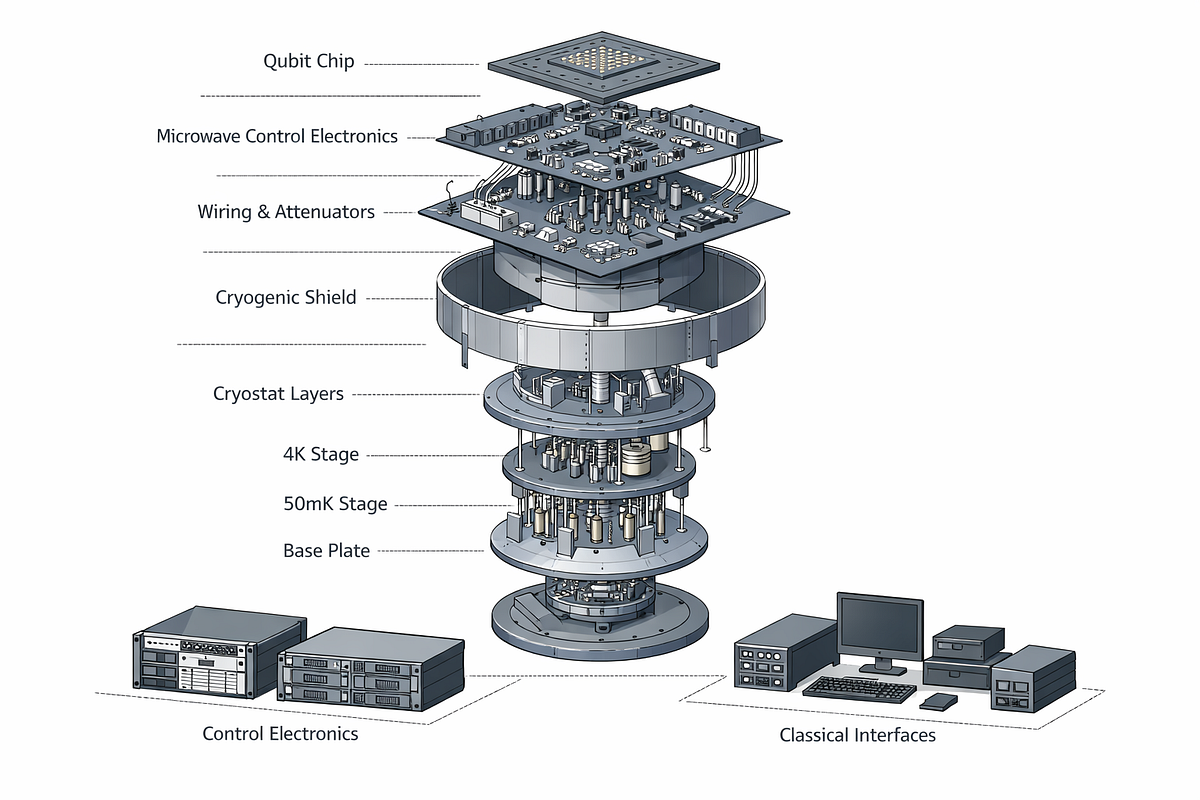
Wiring, control, and calibration overhead often dominate long before qubit counts become large. - Error correction remains expensive.
Logical qubits demand substantial overhead, making full fault tolerance a longer-term proposition than many roadmaps suggest. - Operational realities are underestimated.
Cryogenics, environmental stability, and maintenance introduce non-trivial friction in real deployments.
The common thread is unmistakable: success correlates far more strongly with system engineering discipline than with hardware ambition.
Common Enterprise Mistakes — and How to Avoid Them
Organizations entering quantum computing often repeat the same avoidable errors:
- Chasing qubit counts instead of effective system performance
- Running pilots without clear problem selection criteria
- Treating quantum devices as standalone experiments
- Ignoring benchmarking, error characterization, and workflow latency
- Expecting transformative results on unsuitable workloads
The corrective actions are equally consistent:
- Start with problem-first selection, not technology-first enthusiasm
- Design hybrid workflows from day one
- Benchmark relentlessly at the system level
- Invest in interdisciplinary talent and partnerships
- Align timelines with realistic NISQ-era capabilities
Quantum computing rewards patience, rigor, and architectural humility.
Cloud vs. On-Prem: A Practical View
For most organizations today, cloud-based quantum access is the rational default.
Cloud platforms provide exposure to multiple hardware modalities, rapid iteration, and managed infrastructure — without the capital and operational burden of on-prem systems. Latency and control limitations exist, but they are acceptable for the majority of NISQ-era experimentation.
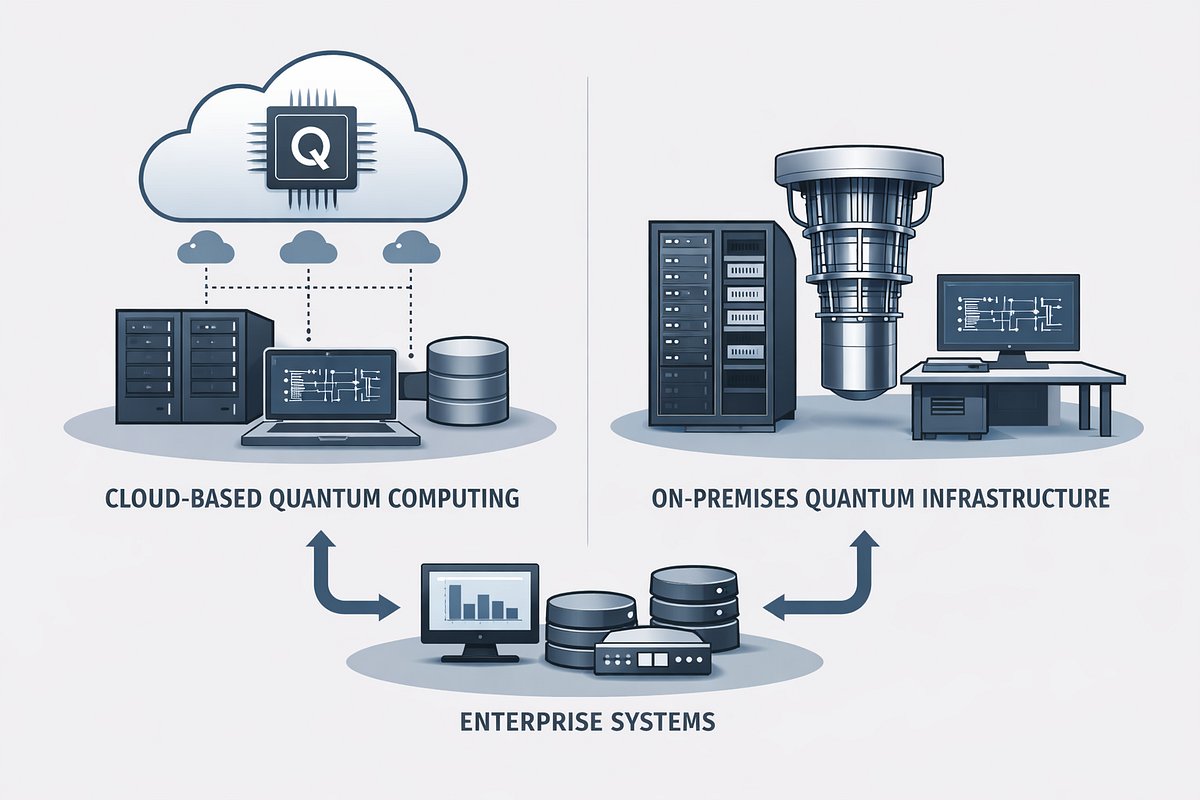
On-premises quantum systems make sense only for organizations with:
- Extreme latency sensitivity
- Stringent regulatory or security constraints
- Deep in-house expertise and long-term funding commitment
Even then, hybrid cloud integration remains unavoidable.
What Will Define Progress in the Next 3–5 Years
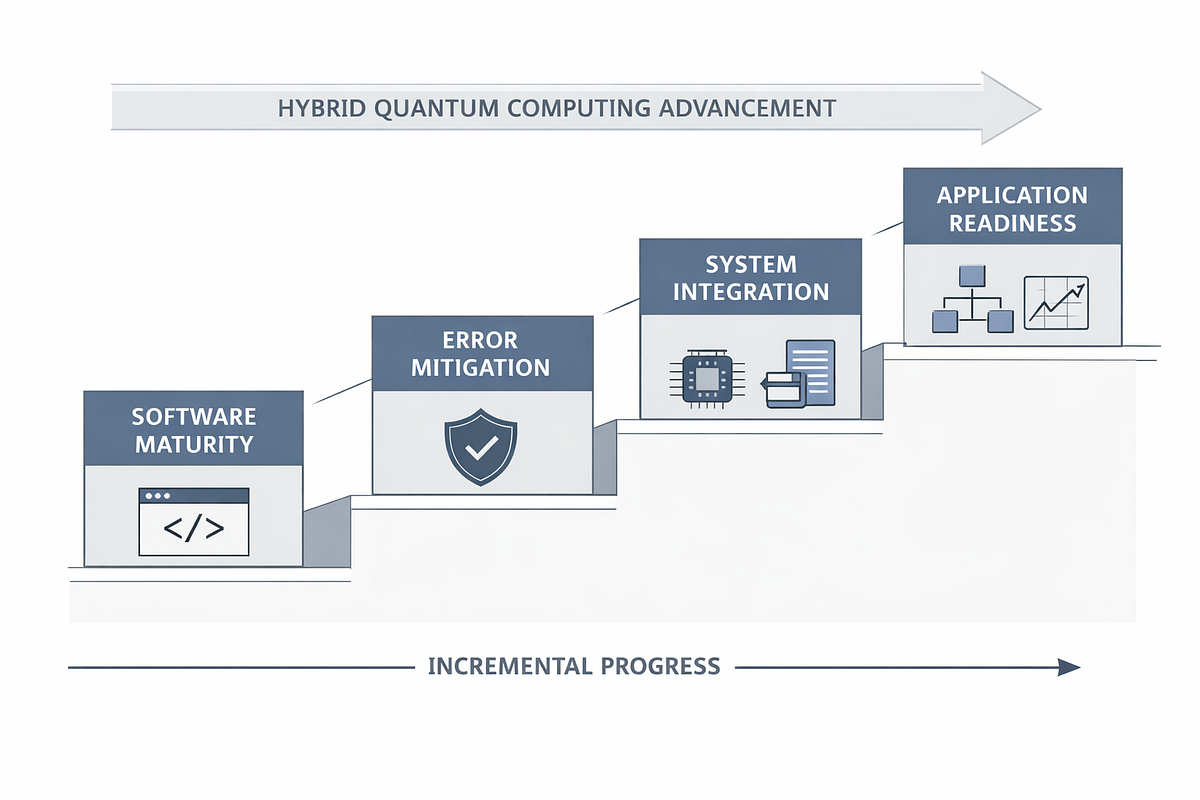
Meaningful advancement will not be marked by singular breakthroughs, but by cumulative system-level milestones:
- Demonstrated hybrid advantage on real, domain-relevant workloads
- Scalable and reproducible error-mitigation frameworks
- Mature compilers, schedulers, and orchestration tools
- Early modular and heterogeneous system prototypes
- Clear benchmarks that connect lab results to enterprise value
Progress will be steady, with punctuated acceleration in focused domains — not a sudden quantum revolution.
Leaders vs. Laggards
The gap between successful and stalled quantum initiatives is widening.
Leaders focus on structured problems, hybrid architectures, disciplined experimentation, and ecosystem engagement. They measure progress realistically and build internal understanding.
Laggards chase headlines, expect miracles, and treat quantum computing as a marketing exercise or speculative bet.
The difference is not access to better hardware — it is clarity of systems thinking.
Final Thought
Quantum computing will not succeed by trying to be something it is not. It will succeed by embracing what it is: a powerful, specialized, and inherently hybrid component of future computing systems.
The organizations that internalize this reality today — engineering quantum systems as part of broader computational ecosystems — will be the ones that extract real advantage tomorrow.
Those waiting for a standalone quantum machine to change everything may be waiting a very long time.


Comments
Post a Comment